Most home theater purchases go wrong in the same order. Someone buys a projector because the spec sheet promises a wall-sized picture, gets it home, and discovers three uncovered windows and a white ceiling. Or they buy a soundbar because it was discounted, mount it under the TV, and still cannot follow dialogue in a British crime drama. A projector and soundbar setup only works when both halves are chosen for the same room at the same time.
I have spent fifteen years installing this gear around Austin and Round Rock, most of it in rooms that were never designed for it: tile floors, open kitchens, a ceiling fan that hums, and a wife who hears a flat note from across the house. What follows is how I sort four very different products into the rooms they actually belong in, and what I tell clients before they hand over a card.
Related: How to Run a Long HDMI Cable Without Signal Dropouts →
Quick answer
There is no single best pairing, and anyone who claims otherwise is selling something. Decide in this order: first, how much light you can keep out of the room; second, how far the seating sits from the screen; third, whether the room can accept rear speakers and a subwoofer. Light control and seating distance decide the projector. Room layout and household tolerance decide the audio.
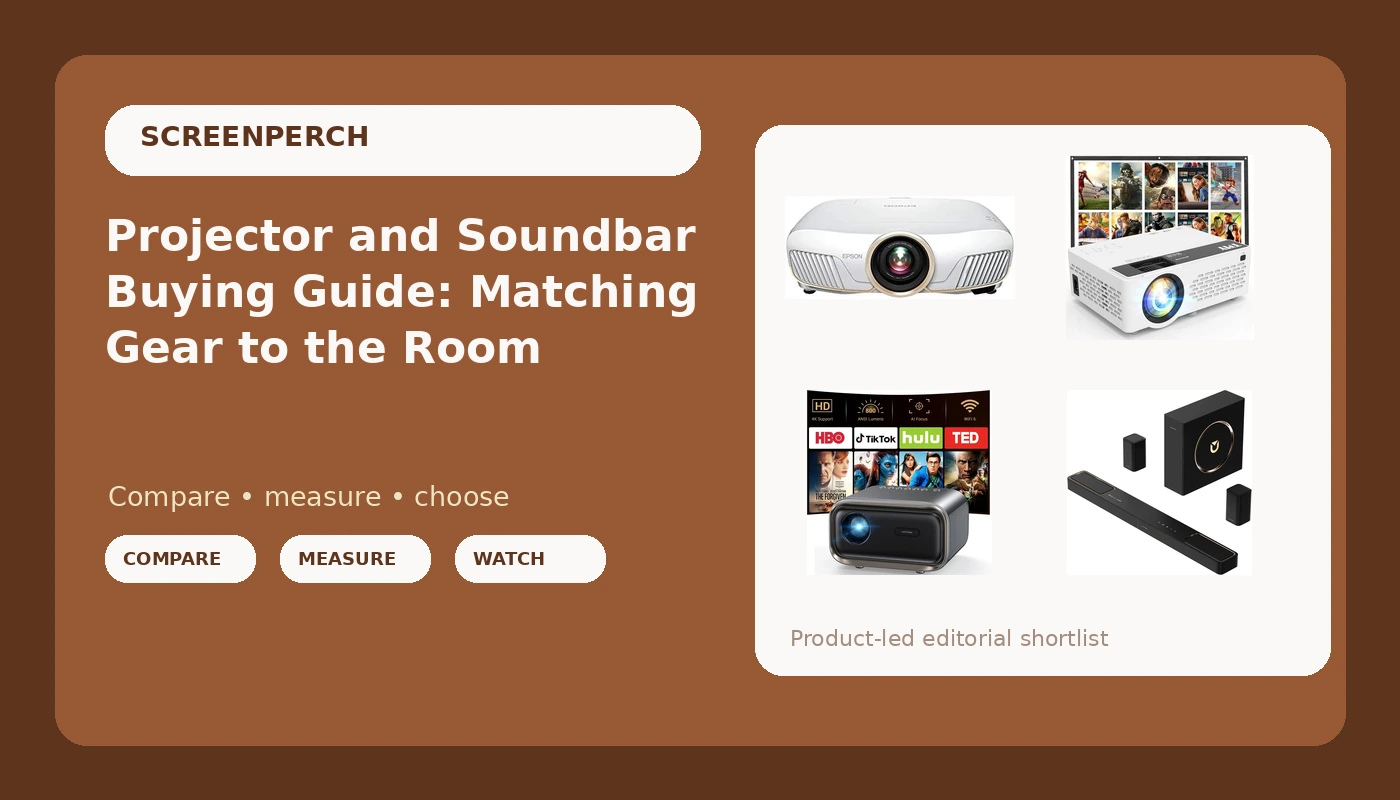
For a light-controlled room with a fixed screen, the Epson Home Cinema 5050UB is the projector to build the room around, with the ULTIMEA 5.1.2ch sound bar covering audio in a shared living space where rear speakers are not welcome. The NICPOW and TMY portable projectors are for flexibility and fast setup, not for reference image quality. Match the display to the room first, then buy audio that fits the same constraints.
4 useful options
| Model | Best fit | What stands out |
|---|---|---|
| Epson Home Cinema 5050UB | Light-controlled dedicated room | 3-chip 3LCD 4K PRO-UHD engine with HDR support |
| ULTIMEA 5.1.2ch Sound Bar | Shared living room with a TV | Dolby Atmos in a 5.1.2 channel layout with surround |
| NICPOW Portable Projector | Rooms that change week to week | Auto focus and auto keystone, plus WiFi and Bluetooth |
| TMY 1080P Mini Portable Projector | A first projector, screen included | 2-way Bluetooth and a bundled 80 inch screen |
The dedicated room pick: Epson Home Cinema 5050UB
This is the one in the group that expects a room to be built around it. A three-chip 3LCD design splits the light into red, green, and blue panels rather than spinning a color wheel in front of a single chip, which is the difference you notice as a steadier image and no rainbow fringing on high-contrast edges. HDR support means it can accept the modern 4K sources you already own.
The trade-off is that everything about it is fixed. It needs a mount, a screen, a measured throw distance, and a cable run you should test before the ceiling gets patched. If the room has a big window you cannot cover, or the seating is closer than the screen size really wants, you are paying for capability the room will never let you see. Buy this one when the room is dark, the seating distance is set, and nobody is going to move the furniture in six months.
The living room pick: ULTIMEA 5.1.2ch Sound Bar
The 5.1.2 label tells you the shape of the system before you open the box: five ear-level channels, one subwoofer channel, and two height channels that fire upward and rely on your ceiling to bounce the sound back down. Dolby Atmos is the format that gives those height channels something to do. In a normal living room, that layout is the realistic compromise between a bare TV and a receiver with wires running to four corners.
Placement decides how much of it you actually hear. A bar sitting on the floor or buried behind a TV stand is a bar you wasted money on. Get it to ear height at the seating position, keep the subwoofer out of a corner if the bass sounds thick, and give the height drivers a flat, hard ceiling to work with. The honest limit: no bar, at any price, replaces real speakers in a dedicated theater room. If you are building a room with four walls and a door, buy speakers. If you are fighting for space in a shared living room, this is the compromise that keeps the peace.
The flexible everyday pick: NICPOW Portable Projector
Read the resolution line carefully, because it is where most buyers get confused. The panel is 1080P. "4K supported" means it will accept a 4K signal and scale it down, not that you get a 4K image. That is not a knock; it is how this class of projector works, and it is why the picture will look sharp with a good source and soft with a bad one.
What you are buying here is convenience. Auto focus and auto keystone mean you can set it on a coffee table, aim it at a wall, and get a rectangular image without a ladder and a level. WiFi and Bluetooth mean a phone or a game console can feed it without a cable across the floor. The trade-offs are real: keystone correction digitally reshapes the image and softens it slightly, and no portable projector of this type survives a bright room. Use it at night, or pull the blinds.
The starter pick: TMY 1080P Mini Portable Projector
The included 80 inch screen matters more than it sounds. A projector aimed at a painted wall gives you whatever color and texture that wall happens to have, and most living room walls are neither white nor flat. Having a screen in the box means the first setup gets a fair chance instead of an accidental handicap. The 2-way Bluetooth is the other practical touch: the projector can feed audio to a soundbar, or work as a Bluetooth speaker on its own.
This is a starter and a second-room projector, and it should be judged that way. It wants a dark room and a short distance to the screen, and it will not hold up against the Epson in a light-controlled theater. What it will do is get a picture up on the wall the same evening you open the box, for a fraction of a fixed install.
Prices and availability may change. Product images, names, and retailer links must be matched by verified ASIN. Do not state a current price, rating, stock status, or measured result without current evidence.
Why spec sheets and real rooms disagree
Brightness claims are the biggest source of disappointment in this category. A manufacturer can publish a number measured under conditions you will never reproduce, and that number travels onto the box as if it were a promise. The only brightness figure that means anything is the one measured in your room, on your screen, with your lamp hours. Treat every lumen claim as an optimistic ceiling rather than a floor.
Audio specs have the same problem with wattage. Power figures on a soundbar box are marketing numbers, not measurements of how loud the thing plays cleanly. What actually matters is headroom: whether the system stays composed at the volume you want, or starts to compress and harden before the dial gets halfway around. A bar with honest headroom at a modest rating will beat a bar with an inflated rating that falls apart at 60 percent.
Channel counts deserve the same skepticism. A 5.1.2 layout is a real, defined thing: five ear-level channels, one subwoofer channel, two height channels. Whether you hear the height channels depends on your ceiling, your seating position, and how far the drivers have to throw. The number on the box describes the design, not your room's response to it.
How to plan the two halves together
The display and the audio are competing for the same room, so plan them in one pass. Throw distance, seating distance, screen size, and speaker positions all interact, and changing one after the fact usually means changing another.
- Measure the seating distance from the wall you plan to project onto, then pick a screen size that suits it. Sitting too close to a big screen is worse than sitting a little farther from a smaller one.
- Audit light control honestly, at the time of day you actually watch. If you cannot darken the room, a fixed high-output projector is the wrong purchase and a portable one is the right one.
- Walk the room and pick a subwoofer location before you buy. Corners reinforce bass, open floor plans swallow it, and a spot that works in one house may be a mess in another.
- Count how many speakers the household will tolerate. If rear speakers will cause an argument, plan for a bar with height channels instead of pretending you will install a 5.1 system later.
- Map the source chain. Streaming device, console, and cable run all need to reach the projector, and long HDMI runs are where installs fail quietly.
What to get right on install day
- Mount the projector so the lens sits level with the screen, and use lens shift where the projector offers it instead of leaning on keystone correction.
- Run and test the HDMI cable before the projector goes on the ceiling, and test it at the resolution and refresh rate you plan to use.
- Set the soundbar at roughly ear height at the main seat, not on the floor and not behind furniture.
- Tune dialogue before you tune explosions. Play a quiet, dialogue-heavy scene first and confirm you can follow it without riding the volume.
- Keep the boxes and receipts for two weeks, and return anything that only sounds good in the store.
Which option should you choose?
Choose the Epson Home Cinema 5050UB when the room can be darkened, the seating distance is settled, and you want a fixed installation you will calibrate and leave alone. Choose the ULTIMEA 5.1.2ch Sound Bar when the room is a shared living space with a TV, rear speakers are not happening, and you want Dolby Atmos height channels without a receiver. Choose the NICPOW Portable Projector when the setup moves between rooms or outdoors and auto focus and auto keystone matter more than a fixed installation. Choose the TMY 1080P Mini Portable Projector when you want a first projector with a screen included and a dark room to use it in.
One caveat that applies to all four: nothing here has been measured in your room, and my opinion of any of them is worth less than a sweep taken from your couch. Buy from a retailer with a return window, set the gear up the way you will actually use it, and let your own ears and eyes make the final call.
The bottom line
Sort the room before you sort the catalog. Light control and seating distance decide whether a fixed projector like the Epson Home Cinema 5050UB makes sense or whether a portable like the NICPOW or the TMY is the honest answer. Household tolerance decides whether audio comes from a surround bar such as the ULTIMEA 5.1.2ch system or from speakers you have not budgeted for yet. Get those two decisions right, and the gear you buy will sound and look like the money you spent. Get them wrong, and no spec sheet will save you.