Related: Soundbar Placement Mistakes That Kill Dialogue
Most people buy the soundbar first and think about the room second. Then they call me because dialogue sounds like it is coming through a bath towel and the sub either vanishes completely or rattles the kitchen cabinets. After fifteen years and roughly 340 installs around Austin, I still start every home theater soundbar and projector conversation the same way: room first, seat second, gear third.
That order matters because the room is the biggest variable in the chain. The same bar that sounds thin in a hard, tiled living room can sound full in a carpeted apartment with a sofa against one wall. No firmware update changes that, and no spec sheet mentions it. This is why I sweep before I judge: a miniDSP UMIK-1 at the actual couch, before and after the bar's room correction runs, tells me more in twenty minutes than a week of reading marketing copy.
What follows is four pieces of gear I would put in a normal living room, not a carpeted showroom. Two budget bars with wireless subs, one 4.1 bar that ships with real rear speakers, and a 4K laser projector for households that want the big picture. I do not print prices in this guide because they move weekly. Each block links to the live listing, so you can check current Amazon price yourself.
One honest warning before the picks. If you are building a dedicated theater room with a dark ceiling and a fixed screen, buy real speakers and an AV receiver. No bar at any price replaces five discrete speakers in a treated room. Everything below is for living rooms, apartments, and family rooms, which is where most people actually watch.
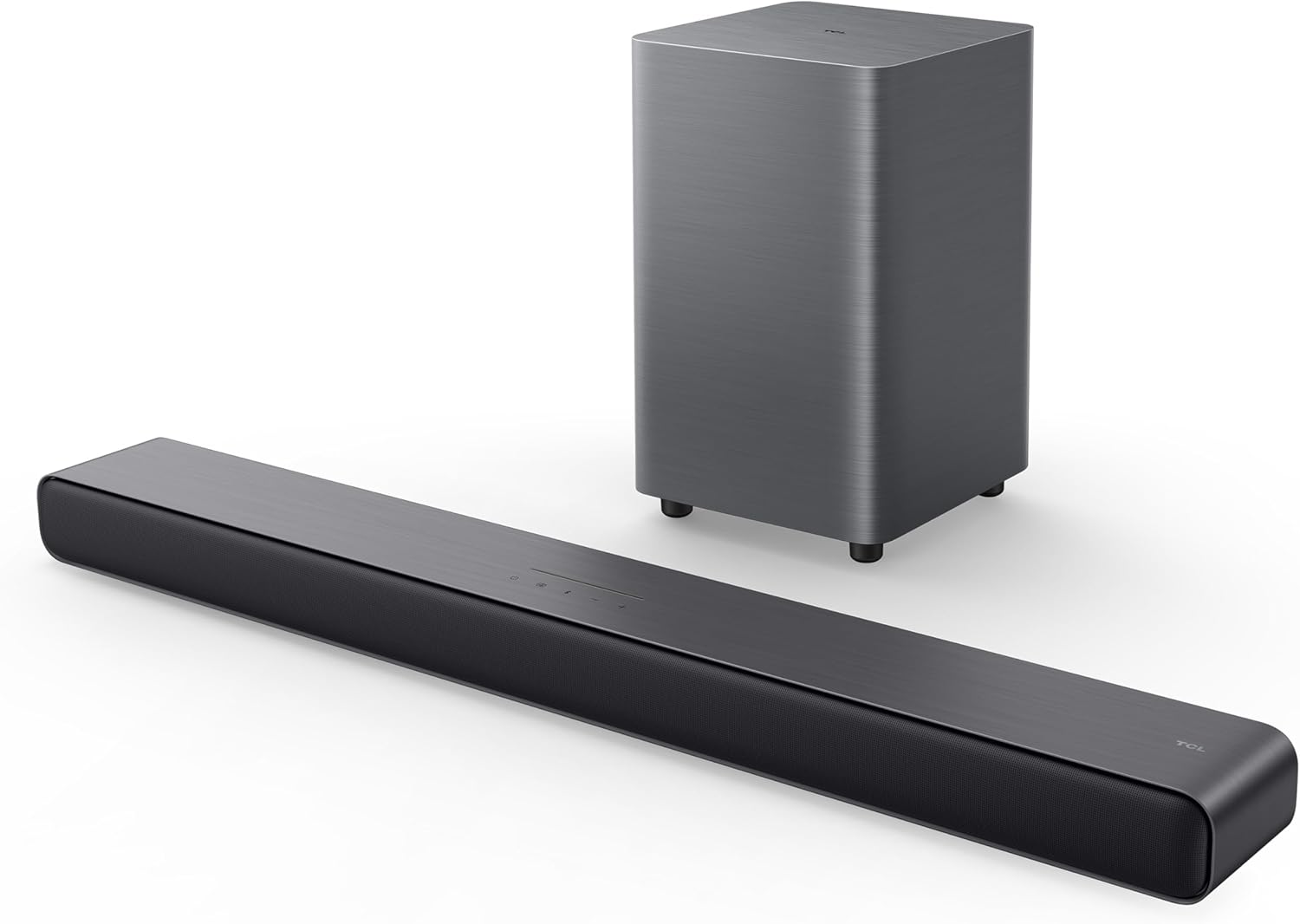
The budget pick: TCL S55H 2.1
The S55H is the bar I would hand someone whose diet is streaming TV, sports, and the occasional movie, and who wants the least possible fuss. It is a 2.1 system: a bar plus a wireless subwoofer. It decodes Dolby Atmos and DTS:X, runs an auto room calibration routine, and gives you both an app and a physical remote. The 220 watts on the box is a manufacturer number, and I treat manufacturer numbers as optimistic until a microphone disagrees with them.
What I actually care about here is the presence band, the 1 to 4 kHz range where dialogue lives. A bar that scoops that range out makes every mumbly British crime drama sound like it is being whispered through a pillow, no matter how many watts the sticker claims. Auto room calibration helps in a hard room, and this bar has it, which matters far more in a tile-floored house than in a carpeted apartment with heavy furniture.
Placement rules come before any of that. Put the bar at the height of your ears when you are seated, not on the floor in front of the TV stand firing at your knees. For the sub, I put on a 50 Hz sine, move the box to each corner with a tape measure, and keep the corner that sounds evenest rather than loudest. Never inside a cabinet, and never tucked behind a couch skirt.
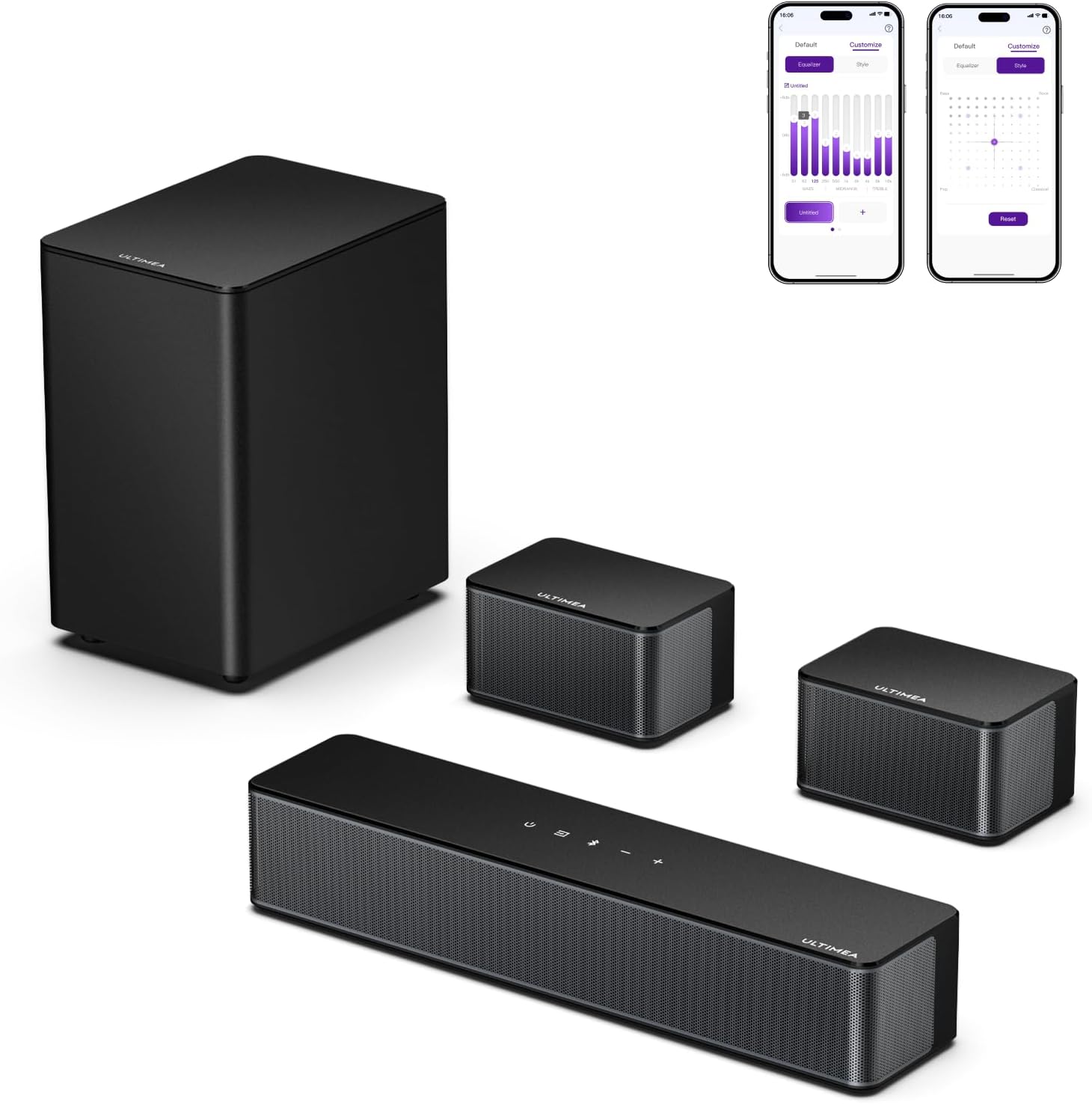
The surround pick: ULTIMEA 5.1 Virtual Surround
Read the name carefully. The 5.1 here is virtual. One bar does the work of several speakers by processing the signal, and there are no separate rear boxes in the carton. That is not a knock, it is the honest description, and it is exactly the right purchase for a renter, a dorm room, a small apartment, or anyone who is not going to run wire and hunt for two outlets behind the couch.
Virtual surround widens the front image and adds a sense of space. It does not put a discrete effect behind your head the way a real rear speaker does, and no amount of processing changes that. What virtual processing does buy you is a massive reduction in installation pain. In a room where the couch is already against the back wall, real rears have nowhere useful to go anyway, so you would be paying for speakers you cannot place correctly.
This is the bar I recommend when someone says they want surround but they are not drilling anything. It handles TV, it handles music, and it does not ask you to become an electrician on a Saturday.
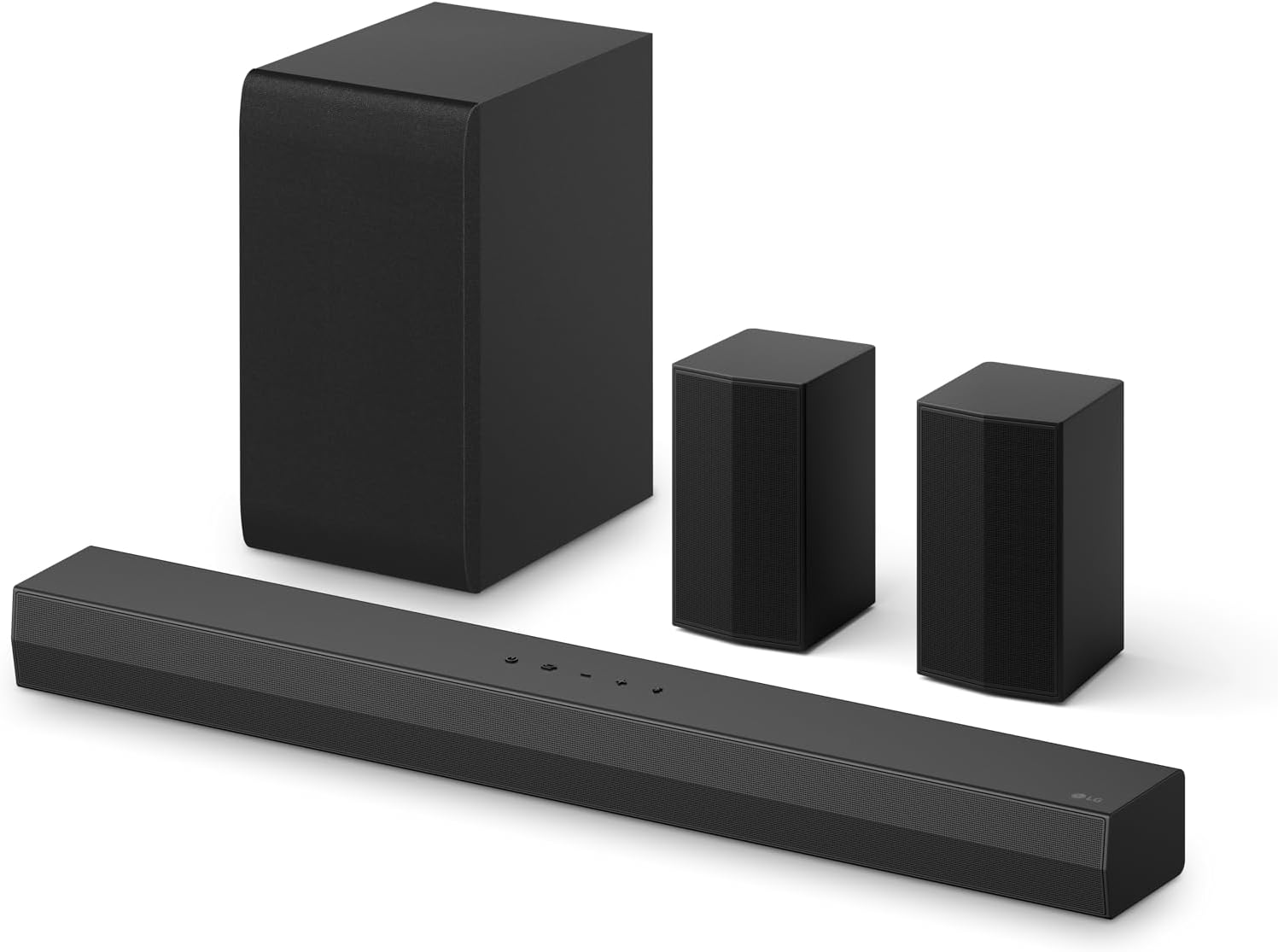
The 4.1 pick: LG S40TR
This is the step up where you get actual rear surround speakers in the box, plus a wireless subwoofer, Dolby Audio decoding, AI Sound Pro processing, and the on-screen interface LG uses across its lineup. Four channels and a sub, with two of those channels sitting behind you. That last part is the whole point of the purchase.
The install detail nobody mentions: wireless rears still need power. Wireless means no speaker cable running across the floor, not no electricity. Before you buy, walk over to your couch and count the outlets. If there are none, budget for extension cords or a slim power strip, or this purchase turns into a family negotiation about a cord across the rug.
Placement for the rears: at or slightly above seated ear height, angled toward the listening seat, not aimed at the ceiling. If they end up at knee level behind the couch cushions, you paid for surround and got mush. Also note that 4.1 has no discrete center channel. The bar handles dialogue on its own, which is normal at this level, but it is a real difference from a setup with a dedicated center speaker.
The big picture: BenQ TK710
If your question is not which bar, but whether to go projector at all, this is the piece to study. The TK710 is a 4K HDR laser projector aimed at movies and gaming. Laser means no lamp to replace and brightness that stays stable over the years instead of dimming toward a lamp swap. The 3200 lumens on the spec sheet is a manufacturer claim, and room light, screen gain, and throw distance decide the final picture far more than the number printed on the box.
Three things decide whether a projector works in your house. First, throw distance. Measure your room before you buy, not after the box arrives. Second, light control. A projector in a bright room with white walls will look washed out no matter how good it is, and no preset menu fixes a sunlit wall. Third, the cable run. At 4K with high refresh rates you need a certified high-bandwidth HDMI cable, and length genuinely matters. I just re-terminated a 30-foot run for the third time because it failed a pattern test at 24 feet. Buy the certified cable, test it on the floor, and only then bury it in a wall.
And budget for a calibration pass. Out of the box, most projectors are not sitting at Rec.709. Delta-E under 3 is the bar I hold a display to, and reaching it usually takes a proper calibration rather than a picture mode labeled Cinema.
The four picks at a glance
| Product | Format | Best for | Notes |
|---|---|---|---|
 Visit on Amazon → Visit on Amazon →ULTIMEA 5.1 Virtual Surround Sound Bar |
Single bar, virtual 5.1 | Renters and back-wall couches | Processing, not physical rears. Visit on Amazon → |
 Visit on Amazon → Visit on Amazon →TCL S55H 2.1 Sound Bar |
Bar plus wireless sub | TV, sports, dialogue first | Atmos and DTS:X decoding, auto room calibration. Visit on Amazon → |
 Visit on Amazon → Visit on Amazon →LG S40TR 4.1 Soundbar |
Bar, sub, real rear speakers | Rooms with outlets near the couch | Rears need power, no discrete center. Visit on Amazon → |
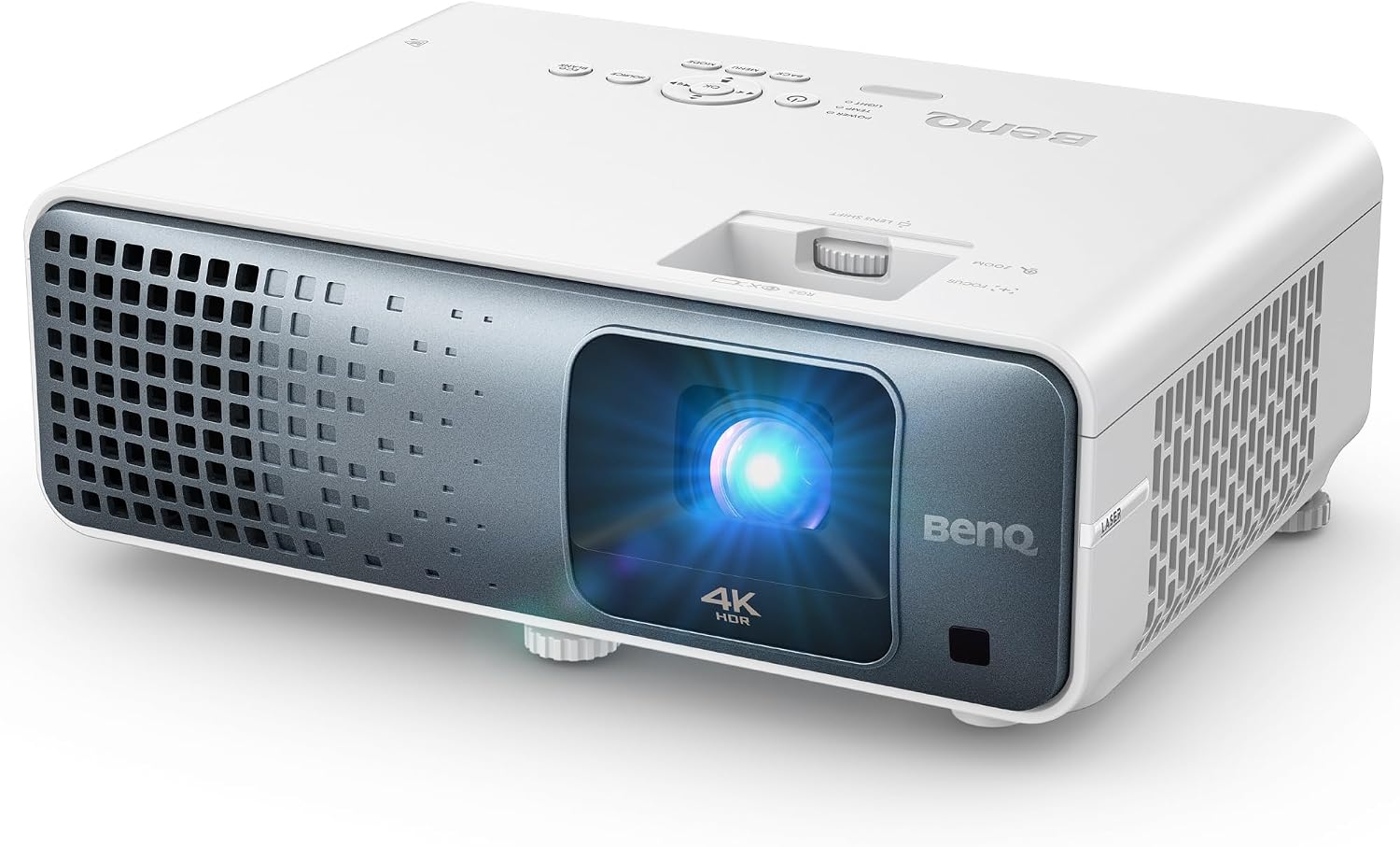 Visit on Amazon → Visit on Amazon →BenQ TK710 4K HDR Laser Projector |
4K HDR laser projector | Big picture in a darkenable room | Needs throw distance math and a certified cable. Visit on Amazon → |
How I judge gear, and what I refuse to publish
Every bar gets the same treatment before I form an opinion. A UMIK-1 sweep from the listening position, before and after the bar's room correction runs, so I can see what the DSP actually did instead of what the menu screen claims. A 60% volume check, because that is where amplifiers with no headroom start compressing and tweeters go harsh. A sub crawl with a 50 Hz sine and a tape measure. And a week of real use in my living room, which has a tile floor, an open kitchen, and a ceiling fan that hums at exactly 60 Hz.
I will not publish a lumen or wattage figure I did not measure myself. I will not review a loaner that comes with strings attached. And I will not recommend a soundbar for a dedicated theater room, even though installing soundbars is how I make a living. If your room is dark, treated, and used only for movies, buy speakers and a receiver and thank me later.
Placement matters more than the product, and it is not close. A modest bar at ear height beats an expensive bar sitting on the floor in front of a cabinet. That is not a slogan. It is the single most common problem I get called out to fix, and it usually costs the homeowner nothing but twenty minutes and a couple of books.
Should you buy the TCL S55H 2.1?
Yes, if your priority is dialogue and simplicity in a normal room. It is the least complicated route to a real wireless subwoofer and Atmos decoding without running a single wire across the floor. Skip it if you want effects behind your head, because that is not what a 2.1 bar does, and no calibration routine will make it one.
Should you buy the ULTIMEA 5.1 Virtual Surround?
Yes, if you cannot or will not place rear speakers. It is the honest answer for apartments, dorms, and couches that already touch the back wall. No, if you expect discrete rear channels, because virtual processing is a convincing illusion, not a speaker behind your head. Buy it for what it is and it will not disappoint you.
Should you buy the LG S40TR?
Yes, if you have two outlets near the couch and want real rear speakers without adding an AV receiver to the furniture. Count the outlets before you order, set the rears at seated ear height, and angle them toward the seat. That is the entire difference between this bar sounding like a system and sounding like a bar.
Should you buy the BenQ TK710?
Yes, if you have a room you can darken, enough throw distance for the screen size you want, and the patience to run a certified high-bandwidth cable and get the picture calibrated. No, if the room is bright all day and you cannot control the light, because a projector that has to fight a sunlit white wall loses that fight every time.