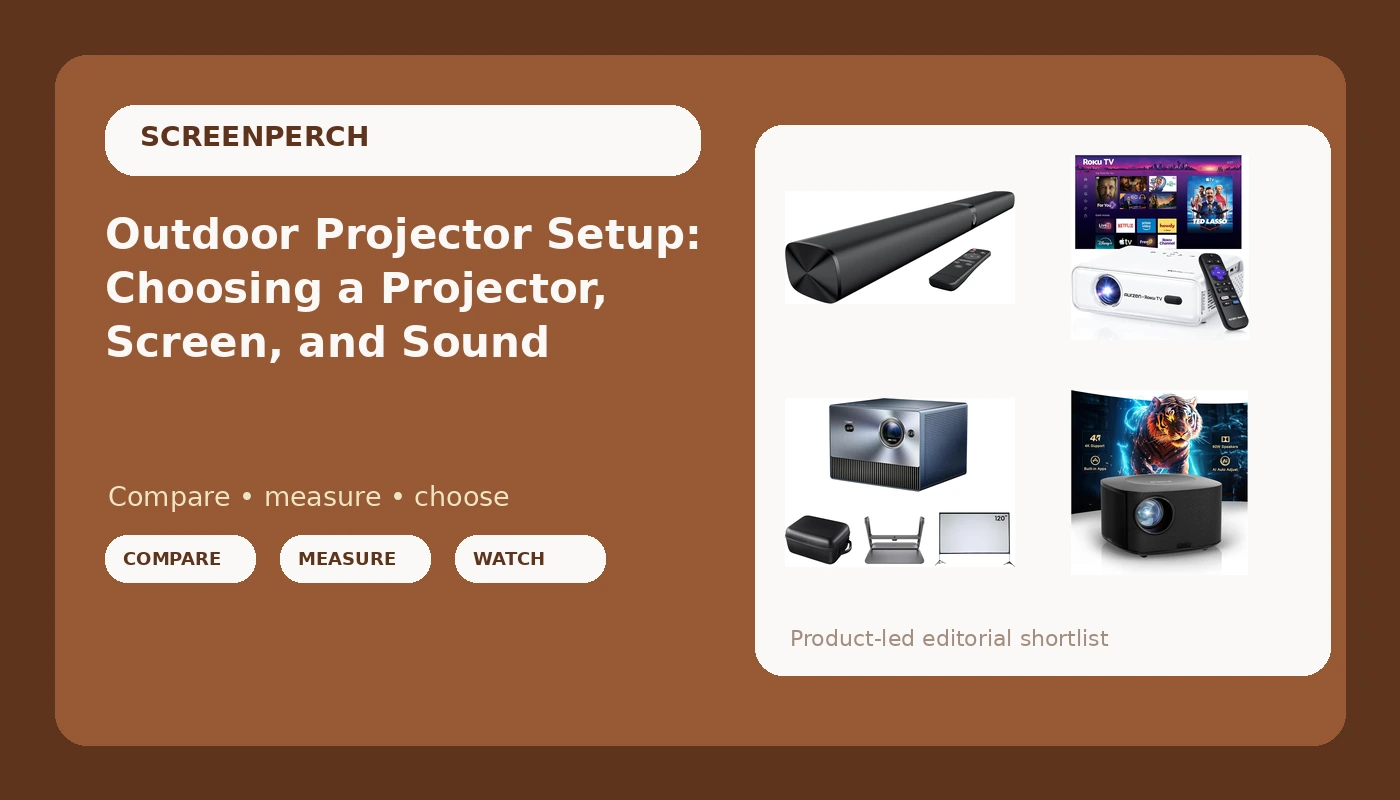
An outdoor projector setup rarely fails because the projector is bad. It fails because the yard is bright, the screen is small, the audio is coming out of a box the size of a paperback, and nobody decided where the extension cord would run. Fix those four things and even a modest projector feels like an event. Skip them and an expensive projector looks like a slideshow on a bedsheet.
The four products below sit at different points on that problem. Two are projectors built to travel, one arrives as a complete bundle with its own screen and gimbal, and one handles only the audio half for people who already own a projector. This is an explainer on what each one is actually for, and how to think about the trade-offs before anything ships.
Related: How to Plan Power and Cables for an Outdoor Movie Night →
Quick answer
Decide the projector first, because the screen, the sound, and the power plan all follow from it. For the simplest path to a bright 4K image outdoors, the Hisense C1 Bundle is the one that shows up with a 120 inch screen, a carry case, and a gimbal in the box. For a first outdoor projector on a tighter budget, the Aurzen Roku TV D1R has the Roku platform built in, so streaming does not require a separate stick. For one box that covers picture and audio together, the ONOAYO Outdoor Projector 4K carries 60W of Dolby audio alongside its 4K imaging. And if you already own a projector whose sound is the weak link, the detachable sound bar addresses only that. None of these is universally the right answer, because the right answer depends on your yard.
Four useful options
| Model | Best fit | What stands out |
|---|---|---|
| Sound Bar for Smart TV, Soundbar with Bluetooth/ARC/Opt/AUX Connect, Auto Volume Boost, 3 Equalizer Modes, 2 in 1 Detachable Soundbar for TV/PC/Gaming/Projectors | Adding sound to a projector or TV you already own | Two-piece detachable design, four connection types, auto volume boost, three EQ modes |
| Aurzen Roku TV D1R Smart Portable Outdoor Projector with WiFi and Bluetooth | A first outdoor projector on a modest budget | Roku TV platform built in, WiFi and Bluetooth, portable chassis |
| Hisense C1 Bundle, 120" Outdoor Screen, Carry Case, Gimbal Included, 4K UHD Triple Laser Portable Projector, Up to 300", Smart OS, Dolby Vision HDR, 110% BT.2020 Color Gamut (Renewed) | A complete, high-output outdoor kit | Triple laser light source, 4K UHD, Dolby Vision HDR, ships with 120 inch screen, carry case, and gimbal |
| ONOAYO Outdoor-Projector-4K with 60W Dolby Audio and Official Licensed Apps | One box for picture and sound | 4K resolution, 60W Dolby audio, officially licensed app store |
The sound fix: Sound Bar for Smart TV, Soundbar with Bluetooth/ARC/Opt/AUX Connect, Auto Volume Boost, 3 Equalizer Modes, 2 in 1 Detachable Soundbar for TV/PC/Gaming/Projectors
This is the option for the person who already has a projector and has discovered that built-in projector speakers are an afterthought. It is not a surround system and it will not pressurize a yard the way a real speaker pair would. What it does is put dialogue somewhere other than a plastic box behind your head. The detachable design matters outdoors more than it does indoors, because you can split the two halves and place them closer to the seating area instead of under a screen that is ten feet away. The ARC input also means one remote for volume on most modern TVs.
The entry point: Aurzen Roku TV D1R Smart Portable Outdoor Projector with WiFi and Bluetooth
The value here is the removal of moving parts. A lot of cheap projector setups turn into a cable puzzle: projector, streaming stick, power brick, HDMI extender, and a phone hotspot. A projector with the Roku platform inside collapses most of that into one device and one login. Bluetooth output is the second useful piece, because it means you can send audio to a speaker or sound bar without hunting for an optical cable in the dark. The trade-off is the usual one for portable projectors: this is a light-and-portable class of product, so ambient light is the enemy, and an outdoor screening with this one works best after the sun is genuinely down.
The complete kit: Hisense C1 Bundle, 120" Outdoor Screen, Carry Case, Gimbal Included, 4K UHD Triple Laser Portable Projector, Up to 300", Smart OS, Dolby Vision HDR, 110% BT.2020 Color Gamut (Renewed)
This is the one to consider when the goal is a finished setup rather than a project. A screen is the single most underrated part of an outdoor system, and buying one separately means matching aspect ratio, gain, and mounting to a projector you may not have chosen yet. The gimbal matters too, since outdoor surfaces are rarely level and stacking books under a projector is how you end up with a trapezoid you cannot fully correct. Two honest caveats: the product is listed as Renewed, which is a condition factor rather than a defect, and the screen size and brightness figures are manufacturer claims, not measurements. Triple laser does hold color better than lamp-based projection as the image dims, but "up to 300 inches" is a maximum diagonal, not a recommendation.
The all-in-one: ONOAYO Outdoor-Projector-4K with 60W Dolby Audio and Official Licensed Apps
Integrated audio is a real convenience outdoors, where every extra cable is another trip hazard and another thing to pack. The trade-off is physics. A speaker inside a projector chassis is close to the screen, so it cannot create much separation between left and right, and it fires from wherever the projector happens to sit. That is fine for a backyard comedy where everyone just needs to hear the dialogue. It is less fine for anything with a real soundtrack. If you want the fewest possible boxes and the simplest pack-out, this is the one that fits that description. If you care about stereo imaging, plan on the detachable sound bar as a companion.
Prices and availability may change. Product images, names, and retailer links must be matched by verified ASIN. Do not state a current price, rating, stock status, or measured result without current evidence.
What the numbers on an outdoor projector page actually tell you
Brightness is the first number people compare and the least useful in isolation. A lumen figure is measured under controlled conditions, and outdoors you are fighting the sky, porch lights, and reflected light off pale siding. A projector that looks punchy in a dark living room can look flat at dusk in a yard. The practical approach is to treat brightness as a threshold question rather than a ranking: is it enough for the ambient light at the hour you actually watch? For most people that means waiting until full dark and accepting that a late summer sunset pushes the start time back further than expected.
Resolution claims deserve the same scrutiny. A true 4K imaging chip is not the same as a 1080p panel that accepts a 4K signal, and both get described as 4K somewhere in a listing. Light source type matters for a different reason. Laser engines fade more slowly and hold color better over their life than lamps, which is why triple laser designs carry wider color gamut claims. HDR support is worth having, but on a projector HDR is mostly about tone mapping, because no projector hits the peak brightness a TV does. A Dolby Vision implementation is a genuine feature; it is not a promise that the image will look like a flat panel.
Throw distance is the spec that decides whether your room, or yard, actually works. Short throw projectors sit close to the screen, long throw ones sit far back, and a projector that needs twelve feet of distance will not work on a patio that is nine feet deep. Measure the space before you fall in love with a model.
Matching sound to a yard instead of a living room
Indoors, walls contain sound and reinforce bass. Outdoors there are no walls, so low frequencies escape and the sound that remains has to travel to seats spread across a lawn rather than a sofa. That changes the requirement: coverage and intelligibility matter more than raw bass extension, and dialogue is the first thing to suffer when a system runs out of headroom.
The 1 to 4 kHz range is where speech intelligibility lives. A system that scoops that region out makes actors sound like they are mumbling into a pillow, no matter how loud the volume goes. This is why the volume boost and EQ modes on a small bar matter more than they would indoors. It is also why placement beats power: a bar or speaker placed near the seating, or split into two pieces on either side of the screen, will out-clear a louder single box sitting ten feet away.
Bluetooth audio is convenient and slightly delayed, which is fine for music and noticeable on lip sync for some viewers. If your projector has ARC or optical out, a wired connection avoids the question entirely. Plan the audio path at the same time you plan the video path, not after.
- Pick the viewing spot and measure how far the projector can sit from the screen, then check that distance against the model's throw range.
- Decide the screen size first, since a 120 inch screen changes both the throw distance and how bright the projector needs to be.
- Confirm your power plan: one circuit, a heavy gauge extension cord rated for the run, and no daisy chained power strips across a lawn.
- Choose the audio path before buying, wired optical or ARC if you want zero latency, Bluetooth if convenience wins.
- Check the streaming source, whether that is a built-in platform, a licensed app store, or an external stick that needs its own power and HDMI run.
Practical guidance for a setup you only build once
- Set up in daylight the first time so you can see cable runs, trip hazards, and where the projector actually needs to sit.
- Bring a level or use the included gimbal, because keystone correction fixes geometry at the cost of some sharpness and brightness.
- Test the whole chain, source, projector, and audio, before guests arrive, since outdoor troubleshooting happens in the dark.
- Keep a power strip inside a dry enclosure and run one cord, not three, to reduce both hazards and hassle.
- Have a fallback for wind. Screens catch gusts, and a stiff breeze turns a taut screen into a sail.
Which option should you choose?
Choose the Sound Bar for Smart TV, Soundbar with Bluetooth/ARC/Opt/AUX Connect, Auto Volume Boost, 3 Equalizer Modes, 2 in 1 Detachable Soundbar for TV/PC/Gaming/Projectors when the projector you own is fine and the audio is the only weak link. Choose the Aurzen Roku TV D1R Smart Portable Outdoor Projector with WiFi and Bluetooth when you want a first outdoor projector with streaming built in and you are willing to watch after dark. Choose the Hisense C1 Bundle, 120" Outdoor Screen, Carry Case, Gimbal Included, 4K UHD Triple Laser Portable Projector, Up to 300", Smart OS, Dolby Vision HDR, 110% BT.2020 Color Gamut (Renewed) when you want a complete 4K kit and are comfortable buying a renewed unit. Choose the ONOAYO Outdoor-Projector-4K with 60W Dolby Audio and Official Licensed Apps when you would rather carry one box than three and can accept the stereo limitations of built-in audio.
A caveat worth stating plainly: the brightness, screen size, and color gamut figures above come from manufacturer listings, and listings are optimistic by nature. A model that suits one yard may be underpowered in another. Buy from a seller with a return window, test the setup in your actual conditions, and let the results in your own space decide.
The bottom line
There is no single right answer in an outdoor projector setup, only a right order of decisions. Settle the projector and its throw distance, then the screen, then the audio, then the power. If you want a finished kit, the Hisense C1 Bundle supplies the screen and gimbal that most people forget. If you want the lowest-friction entry, the Aurzen Roku TV D1R removes the streaming stick from the equation. If you want one box that does both jobs, the ONOAYO covers picture and audio together. And if the picture is already handled, the detachable sound bar is the piece that fixes the part of movie night people actually complain about.