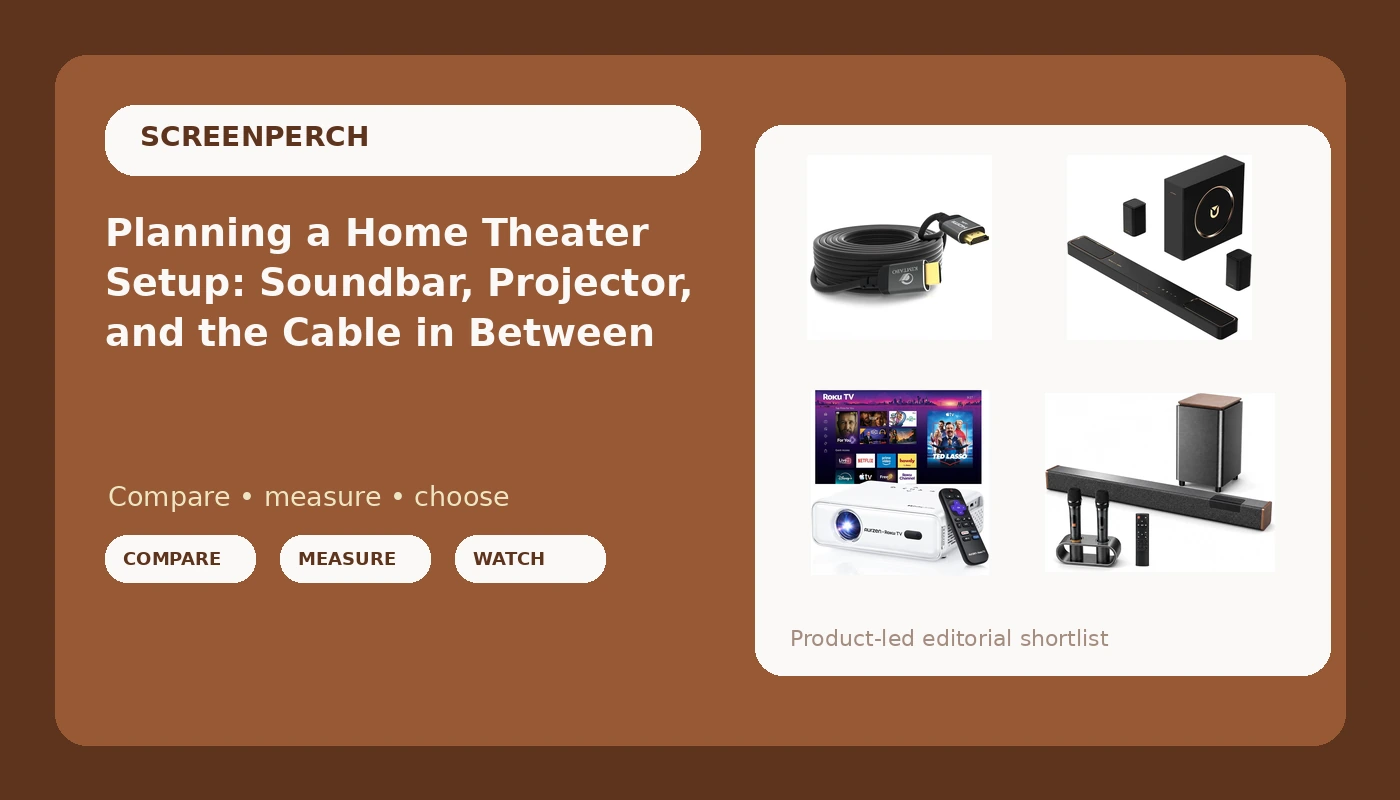
A budget home theater setup rarely fails because one box was bad. It fails because the boxes were chosen separately, in three different moods, without anyone measuring the room. The soundbar gets picked for the wattage printed on the front, the projector for the brightness claim on the box, and the cable at whatever length happened to be left on the shelf. Fifteen years and roughly 340 installs later, the cleanup is always the same job: figure out where people sit, where the picture lands, and how far the signal has to travel, then buy the pieces that fit those three answers.
That order matters more than any single product, because the four items below solve four different problems. One is a surround system for a fixed wall. One is a party bar with microphones in the box. One is a projector that can move from the living room to the yard. And one is a 30-foot cable that quietly decides whether the other three can be placed where they belong.
Related: Cable Management for a Clean Home Theater Install →
Quick answer
Plan the room first, then match the gear to it. For a fixed TV wall where surround effects matter, the ULTIMEA 5.1.2ch Sound Bar with Dolby Atmos is the piece that anchors a 5.1.2 layout. For a room that hosts people and karaoke nights, the 160W Soundbar with Subwoofer & 2 Karaoke Mics covers the same wall with microphones included. If the picture has to move, the Aurzen Roku TV D1R Smart Portable Outdoor Projector carries its own streaming platform and wireless connections. And when the source rack sits farther from the screen than a normal cable can reach, the 30 ft HDMI Cable 4K closes that gap. None of these is automatically right for your room. The room decides.
Four useful options
| Model | Best fit | What stands out |
|---|---|---|
| ULTIMEA 5.1.2ch Sound Bar with Dolby Atmos, Surround Sound System for TV | A fixed TV wall where you want height and surround channels | 5.1.2 channel layout with Dolby Atmos support |
| 160W Soundbar with Subwoofer & 2 Karaoke Mics for TV Home Theater | Movie nights that turn into group singing | Subwoofer and two karaoke microphones included |
| Aurzen Roku TV D1R Smart Portable Outdoor Projector with WiFi and Bluetooth | Rooms and yards without a permanent screen | Built-in Roku TV platform, WiFi, and Bluetooth |
| 30 ft HDMI Cable 4K, High Speed Long HDMI Cables (9.14m) | Long runs from a source rack to a projector or wall-mounted TV | 30 ft length with ARC support and 4K 30Hz rating |
The Atmos centerpiece: ULTIMEA 5.1.2ch Sound Bar with Dolby Atmos
The numbers in a 5.1.2 label are not marketing fluff, they are a channel map: five ear-level channels, one subwoofer channel, and two height channels. That last pair is what separates an Atmos-capable bar from a plain stereo one, because height information is what makes a helicopter sound like it is above you instead of beside you. What the label cannot tell you is whether those height channels will actually reach your ears. Ceiling height, seating distance, and whether the bar sits at ear level or on a low console all change the result. In my experience the height effect is the first thing to disappear in a room with a low ceiling or a bar buried under the TV. If you want the full 5.1.2 layout to do its job, give it a wall with some air above the seating position.
The party bar: 160W Soundbar with Subwoofer & 2 Karaoke Mics
Here is where I have to be honest about numbers. A wattage rating on a box is not a measurement of how loud a bar plays before it distorts; it is a manufacturer's figure, and it says nothing about headroom. What the 160W figure does tell you is the class of product: this is a bar with a separate subwoofer, not a slim all-in-one relying on tiny drivers for bass. The two included microphones are the genuinely unusual part. Most bars treat karaoke as an afterthought that requires buying a separate wireless mic set, so a package that ships with two is aimed at a specific kind of household, one where the TV doubles as a party system. If your living room is a quiet two-person setup, you are paying for hardware you will not use.
The portable screen: Aurzen Roku TV D1R Smart Portable Outdoor Projector
Projectors are the category where the gap between the box and the room is widest. Every projector is sold with a brightness figure, and every one of those figures is measured under conditions your living room will never reproduce. Ambient light is the enemy: a projector that looks vivid after sunset can look washed out at 4 p.m. with a west-facing window open. The built-in Roku TV platform is the practical advantage here, because it means the projector does not need a streaming stick hanging off the back or a laptop tethered to it. Bluetooth gives you a path to send audio to a bar or speaker instead of relying on whatever small driver is inside the chassis. The trade-off is that a portable projector is a compromise by design: it moves easily, and it gives up brightness and contrast to do so.
The long run: 30 ft HDMI Cable 4K
Read the frame rate on this one before you buy it. The listing rates this cable at 4K 30Hz, which means 4K resolution at 30 frames per second, along with 2K, 1080p, and 3D support. If your source is a console or a PC pushing 4K at 60Hz or higher, this is not the cable for that job, and no amount of gold plating changes a spec. What it is good for is the run itself. ARC support matters because it lets audio travel from the TV back down the same cable to a soundbar, which is exactly the situation a long wall-mounted install creates. The soft cord jacket helps on a 30-foot pull through a wall cavity or along a baseboard, where a stiff cable fights every corner.
Prices and availability may change. Product images, names, and retailer links are matched to verified listings. No current price, rating, stock status, or measured result is stated here without current evidence.
Why the room beats the spec sheet
I have swept enough rooms with a measurement mic to know that the biggest variable in any of these setups is not the box, it is the space. Three things ruin more systems than any firmware bug.
The first is placement. A soundbar sitting on a low console, firing at the listener's knees, will sound mumbly no matter what it costs. The dialogue band lives between roughly 1 and 4 kHz, and that range is directional. Get the bar up near ear height, or angle it, and the same product suddenly sounds clearer.
The second is bass behavior. A subwoofer jammed into a corner gets a boost at some frequencies and a cancellation at others, and the result is boominess that people blame on the bar. Moving the sub a couple of feet along the wall, or to a different wall entirely, often fixes more than any EQ setting.
The third is the room's own noise floor. In my house it is a ceiling fan that hums at exactly 60 Hz, which sits right where a subwoofer does its work. If your room has a hum, a rattling cabinet, or a hard tile floor that slaps sound back at you, deal with that before you upgrade anything. DSP room correction can help a lot, but it cannot fix a bar with no headroom, and it cannot fix placement. It only fixes what the room did to the sound after the sound left the speaker.
How to plan the signal chain
- Measure the seating position and the screen location first. Write the distance down. Every other decision, including bar size and projector placement, follows from that number.
- Walk the cable path with a tape measure, not an estimate. If the run is longer than a standard cable, plan for a 30-foot option like the one above and check its rated resolution and frame rate against your source.
- Choose the audio layout based on the room shape. A narrow room with seating against a wall rarely benefits from surround channels behind the couch; a wider room with space behind the seats can use them.
- Confirm how the TV and the audio will talk to each other. ARC over HDMI carries audio back down the cable from the TV to the bar, which is the cleanest option when both devices support it.
- Set everything up, listen for a week, and move the sub before you consider returning anything. Most "defective" subwoofers are just badly placed subwoofers.
Practical guidance for a real living room
- Get the soundbar to ear height or close to it. A wall mount or a riser costs less than a new bar and fixes more.
- Pull the subwoofer out of the corner and test two or three positions along the wall before settling.
- Measure the HDMI run along the actual path, including the bend around a door frame. A cable that is one foot short is a cable that does not work.
- Match the cable's rated frame rate to your source. A 4K 30Hz cable is the right part for a projector and the wrong part for a 4K 120Hz console.
- Kill the room's hum sources first. A fan, a dimmer, or a buzzing power supply will mask every improvement you make afterward.
- For a portable projector, test the picture at the time of day you actually watch. A wall that looks great at night can be a washout at noon.
Which option should you choose?
Choose the ULTIMEA 5.1.2ch Sound Bar with Dolby Atmos when you have a fixed TV wall, space above and behind the seating, and you want height and surround channels rather than just a louder version of the TV speakers. Choose the 160W Soundbar with Subwoofer & 2 Karaoke Mics when the room is social, the household sings, and you would rather have the microphones and the subwoofer included in one purchase. Choose the Aurzen Roku TV D1R Smart Portable Outdoor Projector when the picture has to move between rooms or out to the yard, and when a built-in streaming platform saves you from adding another device. Choose the 30 ft HDMI Cable 4K when the source and the screen are simply too far apart for a normal cable, and when 4K 30Hz matches what you actually feed it.
A caveat that applies to all four: nothing here is a substitute for a dedicated theater room with real speakers and a fixed screen. If you have that room, buy speakers. These products exist for the living room, the apartment, the spare bedroom, and the backyard, and they should be judged against those rooms.
The bottom line
A home theater setup is a sequence, not a shopping list. Measure the room, decide where the picture and the people go, then buy the audio and the cable that reach that arrangement. The ULTIMEA 5.1.2ch bar carries the surround job on a fixed wall. The 160W bar with subwoofer and microphones covers the social room. The Aurzen Roku TV D1R handles the portable and outdoor case with its own streaming platform built in. The 30 ft HDMI Cable 4K handles the distance, as long as you respect its 4K 30Hz rating. Get the placement right and any of these will outperform a more expensive system dropped into a corner.