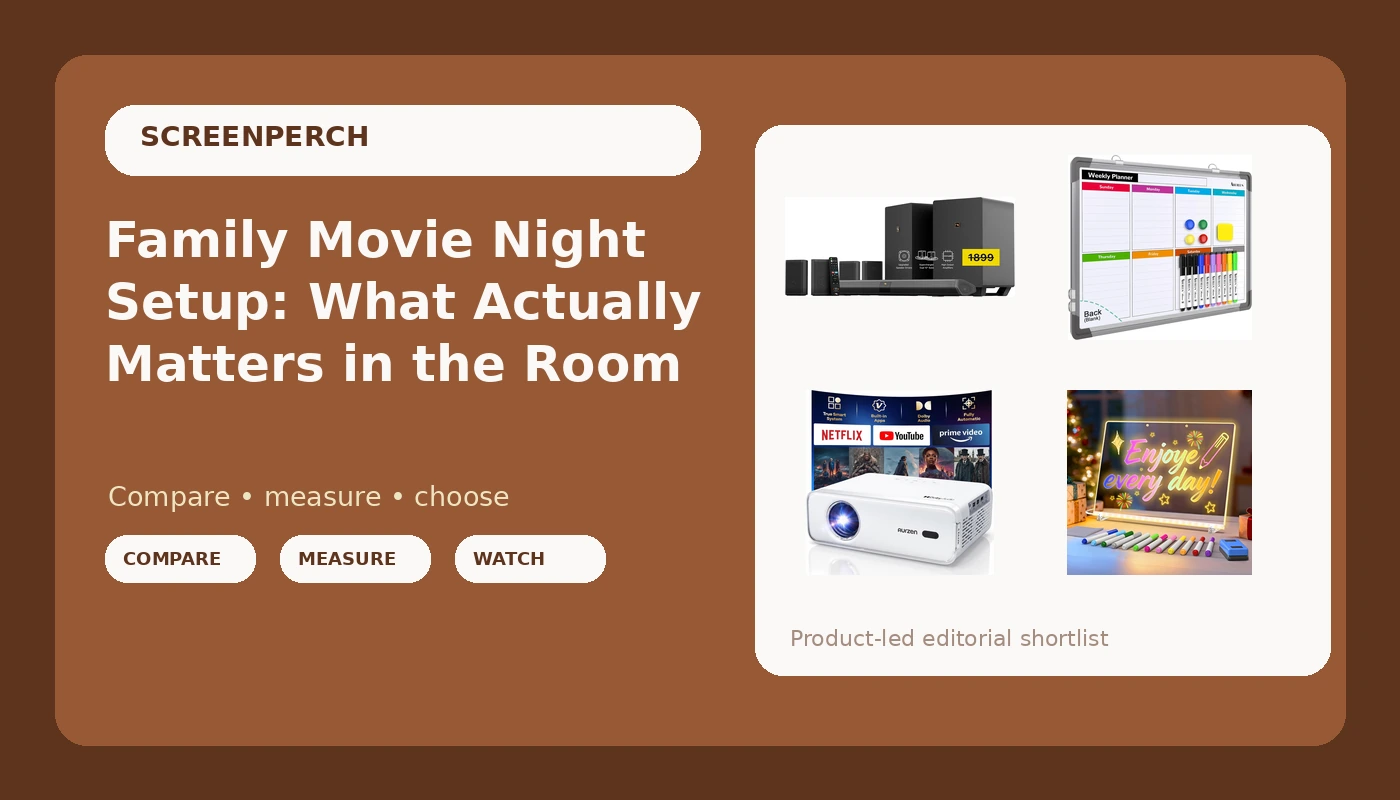
Most people build a family movie night setup backwards. They buy the biggest screen they can afford, plug it into whatever sound they already own, and then spend a year wondering why the whole thing feels flat. A family movie night setup is not one purchase. It is a picture decision, a sound decision, and a short list of small decisions about the room itself, and the small ones are the ones everybody skips.
I have spent fifteen years hanging screens and sweeping soundbars in other people's houses, and the pattern never changes. The gear gets the budget. The room gets the leftovers. Then the room wins anyway, because a projector pointed at a beige wall and a subwoofer jammed into a corner will beat the spec sheet every single time. What follows is how I think through the whole setup, including the two pieces that have nothing to do with audio or video and still end up mattering more than people expect.
Related: How to Place a Subwoofer in a Real Living Room →
Quick answer
Decide the picture and the sound first, because everything else in the room is support for those two choices. For picture, the real question is whether the screen stays in one place or moves, since a portable projector and a fixed installation solve different problems. For sound, the question is whether the room can take a full surround system or needs one bar that handles everything itself. Then budget for the two items nobody plans for: a way to schedule a shared room when more than one person wants it, and a low-light activity for the kids who will not sit still through a two hour film.
Four useful options
| Model | Best fit | What stands out |
|---|---|---|
| Shockwafe 9.2.4 Dolby Atmos/DTSX Surround Soundbar Sys-Dual 10" Subs*1300W | A room where the bar is the entire audio system | Dolby Atmos and DTS:X processing with two 10-inch subwoofers included |
| Aurzen EAZZE D1 Smart Portable Outdoor Projector with WiFi and Bluetooth | Backyard nights and rooms where the screen has to move | Built-in WiFi and Bluetooth streaming in a portable body |
| Weekly Calendar Whiteboard for Wall, Dry Erase Board, Magnetic White Board | A shared room with more than one person claiming it | Magnetic dry-erase surface laid out as a weekly calendar |
| LED Drawing Board for Kids - 13.7x10.6 Inch, rasable Acrylic Doodle Pad, Display Booths,with 12 Fluorescent Markers,Stand,4 Modes & 7 RGB Colors - Creative Fun & Christmas Gift for Grandkids | Younger kids who need something to do in low light | Erasable acrylic pad with 12 fluorescent markers, a stand, 4 modes, and 7 RGB colors |
The sound: Shockwafe 9.2.4 Dolby Atmos/DTSX Surround Soundbar Sys-Dual 10" Subs*1300W
The trade-off here is scope. A system like this replaces the receiver, the speakers, and the subwoofers with one purchase, which is exactly what makes it attractive to a family that does not want a rack of components and four remotes. It also means the room has to give it somewhere to sit. The two subwoofers are the part people underestimate: they need floor space and a wall outlet each, and they will find every rattle in a room with a loose shelf or a picture frame that is not flat against the wall. If the room cannot surrender that space, a bar with a single sub is the more honest choice, and I will say so even though it is a smaller sale.
The picture: Aurzen EAZZE D1 Smart Portable Outdoor Projector with WiFi and Bluetooth
Portable projectors trade ceiling-mounted precision for flexibility, and that trade deserves to be named out loud. A unit that lives on a shelf and never moves can be aligned once and forgotten for years. A unit that goes out to the yard every Friday gets bumped, and every bump costs you keystone correction and focus before the movie starts. If your plan is ninety percent indoors, mount something and be done. If your plan is genuinely a backyard on summer evenings, portability is the feature you are paying for, and you should accept the five minutes of setup that comes with it.
The schedule: Weekly Calendar Whiteboard for Wall, Dry Erase Board, Magnetic White Board
This is the piece that sounds like filler and is not. A media room in a house with kids is a shared resource, and shared resources get argued over. A weekly calendar on the wall turns "who gets the room Friday" into a fact everyone can read. It is also where the small logistics live: the movie start time, whose turn it is to pick, and which night the room is offline because somebody has a project due. Installers never put this on an invoice and every household needs one.
The kids' corner: LED Drawing Board for Kids - 13.7x10.6 Inch, rasable Acrylic Doodle Pad, Display Booths,with 12 Fluorescent Markers,Stand,4 Modes & 7 RGB Colors - Creative Fun & Christmas Gift for Grandkids
Low-light activities for kids are the least glamorous purchase in the whole setup and the one that saves the evening. A backlit drawing pad gives a younger kid something to do at the edge of the light without a phone screen blasting the room. It is not a babysitter and it will not hold a nine-year-old for a full feature, but for the twenty minutes while the adults get the projector focused and the sound running, it earns its place in the corner.
Prices and availability may change. Product images, names, and retailer links must be matched by verified ASIN. Do not state a current price, rating, stock status, or measured result without current evidence.
Why the room decides more than the spec sheet
Every number on a box was produced somewhere that is not your house. Power ratings, brightness figures, and channel counts come from controlled conditions, and controlled conditions do not include a ceiling fan humming at 60 Hz, a tile floor that slaps midrange back at the couch, or a subwoofer pushed into a corner because that is where the outlet is.
The practical version of that lesson is simple. Two rooms with identical gear can sound completely different, and the difference is placement. A soundbar sitting inside a cabinet, below ear height, with its drivers firing at a shelf edge, will mumble dialogue no matter what its processing claims. The same bar on a shelf at seated ear height, with a foot of air in front of it, will sound like a different product. Before you spend anything, look at where the bar would actually go, because that location is doing more for your dialogue clarity than any upgrade you can buy.
The same logic applies to the picture. A projector is only as good as the surface it hits and the light it fights. A wall with a warm paint tint will shift every color on screen, and a room with an uncovered window will wash out a projected image in the middle of the afternoon regardless of what the marketing page says about brightness. Blinds and a screen matter as much as the projector in that situation.
And the room is not only physics. It is also people. A setup that only works when everyone cooperates is a setup that stops getting used by February.
How to size the setup to the space you actually have
Start with seating distance, not screen size. Sit where you will actually sit, measure from your eye to the wall, and let that number drive how large the image should be. Too large and you will be turning your head like you are at a tennis match. Too small and the whole exercise is pointless.
Then count what the room will give up. Rear speakers need floor or wall space behind and beside the seats, and they need power or a cable run to get there. Two subwoofers need two spots on the floor. If the honest answer is that the room will give up nothing, choose a system that puts everything in one place rather than one that asks the room to change.
Finally, separate the permanent from the portable. Anything that gets moved has to be re-aligned, re-focused, and re-tested every time, so portable gear should be reserved for the setups that genuinely move. Everything else should be installed once and left alone.
- Measure the room before you buy anything: width, seating distance, and how much floor space you are willing to surrender.
- Decide whether the picture is fixed or movable, because that single choice eliminates half the projector market.
- Decide whether the room can support rear speakers or needs one system that handles everything from a single position.
- Count outlets and cable runs. Every wireless claim still needs power at both ends of the chain.
- Test the room with what you already own, and do it before the return window closes.
Practical guidance
- Set the screen so the center of the image sits near eye level from your normal seat, not up near the ceiling.
- Give a subwoofer a corner only after you have listened to it there. A corner can double the bass or turn it to mud depending on the room.
- Plan for ambient light. A projector that looks great at night will look washed out at four in the afternoon with the blinds open.
- Keep the streaming device on one input and one remote, because family setups fail on complexity far more often than they fail on hardware.
- Write the schedule somewhere visible. Whoever picks the movie should be able to see whose turn it is without asking.
Which option should you choose?
Choose the Shockwafe 9.2.4 Dolby Atmos/DTSX Surround Soundbar Sys-Dual 10" Subs*1300W when the room is the theater and you want one purchase to cover the entire audio chain, including the low end. Choose the Aurzen EAZZE D1 Smart Portable Outdoor Projector with WiFi and Bluetooth when the screen has to move between the living room and the yard and built-in streaming keeps the setup simple. Choose the Weekly Calendar Whiteboard for Wall, Dry Erase Board, Magnetic White Board when more than one person shares the room and the schedule keeps turning into an argument. Choose the LED Drawing Board for Kids when younger kids will be in the room after dark and need something to do that does not involve another screen.
None of this replaces measuring your own space. Manufacturer power and brightness figures are claims, not results, and the only numbers that matter in the end are the ones you can verify from your own couch.
The bottom line
A family movie night setup comes down to two real decisions and two small ones. The picture and the sound carry the experience, so the question for each is whether the room supports a fixed installation or demands flexibility. The small ones, a visible schedule and a low-light activity for the kids, are what keep the room usable once the novelty wears off. Buy for the room you have, not the room in the marketing photos, and check the return policy before you commit, because a bar that sounds wrong in your living room is a bar that sounds wrong no matter what its power rating says.