Most people shopping a home theater projector and soundbar buy the two pieces on separate weekends, install them on a third, and then wonder why the picture looks washed out and the dialogue sounds like it is coming through a towel. I have spent fifteen years crawling through Austin attics and something like 340 installs, and the pattern never changes: the room decides more than the box does. This comparison is not about which of these four products wins a spec fight. It is about which pair belongs in the room you actually have, with the light you actually have, and the family you actually have.
The short answer: if you are building a room you will calibrate once and keep dark, pair the Epson Pro EX9270 with the Elimavi 5.1 system. If you want something that works the day it arrives, in a living room or on a patio, pair the Smart Projector 4K with the ULTIMEA 7.1ch sound bar. Everything below is why, plus the trade-offs I would make you sign off on before I ran a single cable.
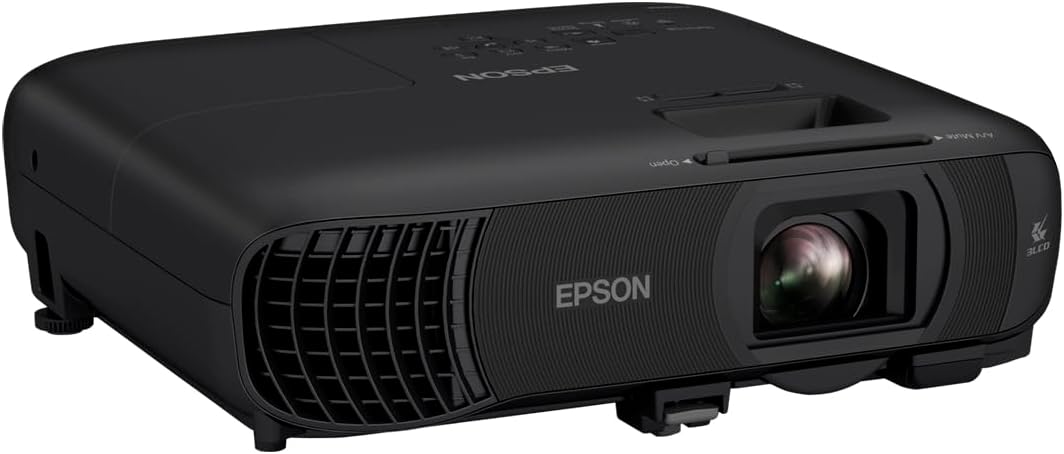
Epson Pro EX9270 Wireless 1080p 3-Chip 3LCD Business Projector
Three-chip 3LCD color that holds up to a calibration pass, wireless input, built for a fixed install
No streaming apps, no speakers worth using, you supply every source
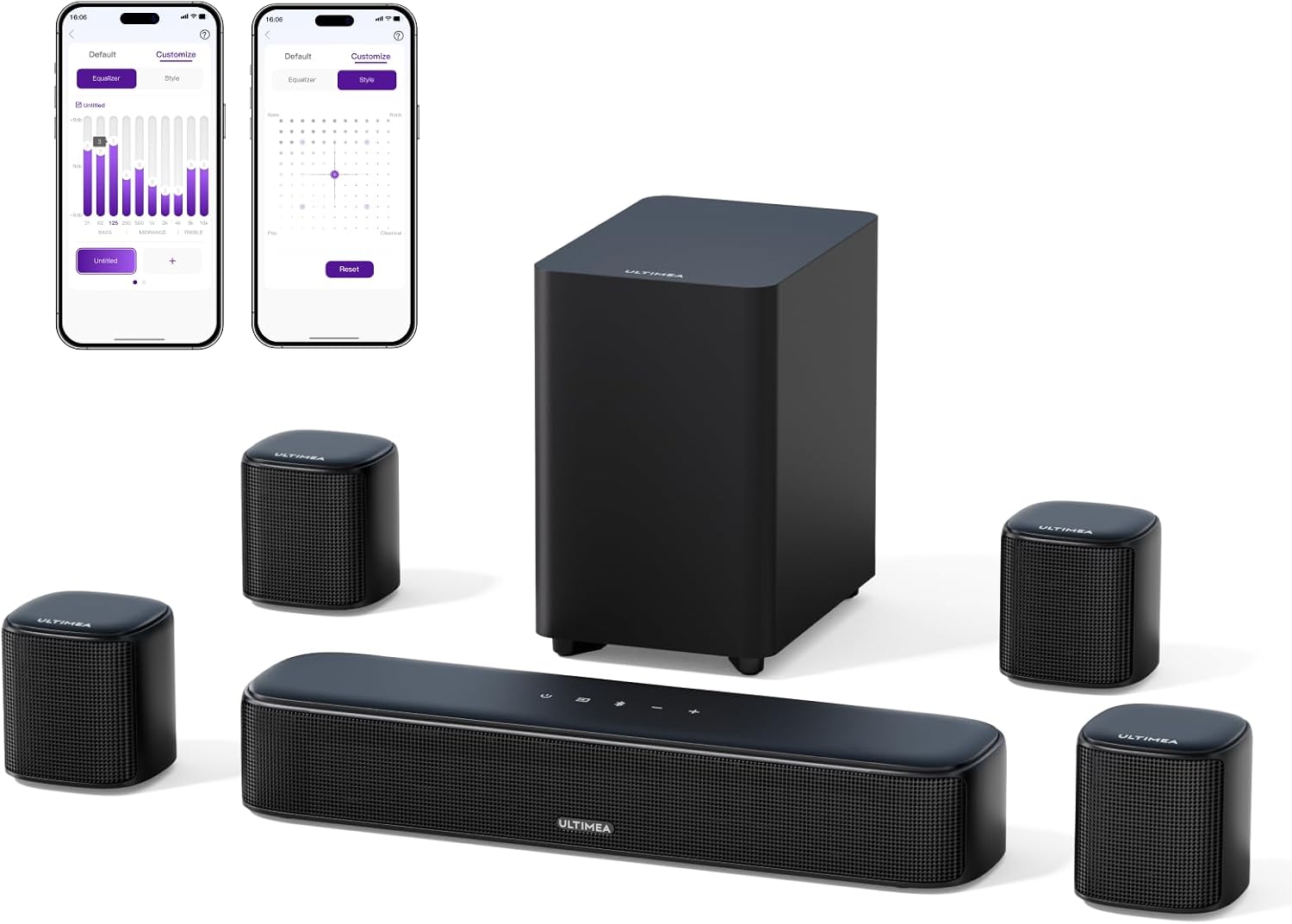
ULTIMEA 7.1ch Sound Bar w/Subwoofer, Virtual Surround System for Smart TV
Bar and subwoofer in one box, no rear speaker wire, easy for a TV to drive
Virtual surround is processing, not speakers behind your head
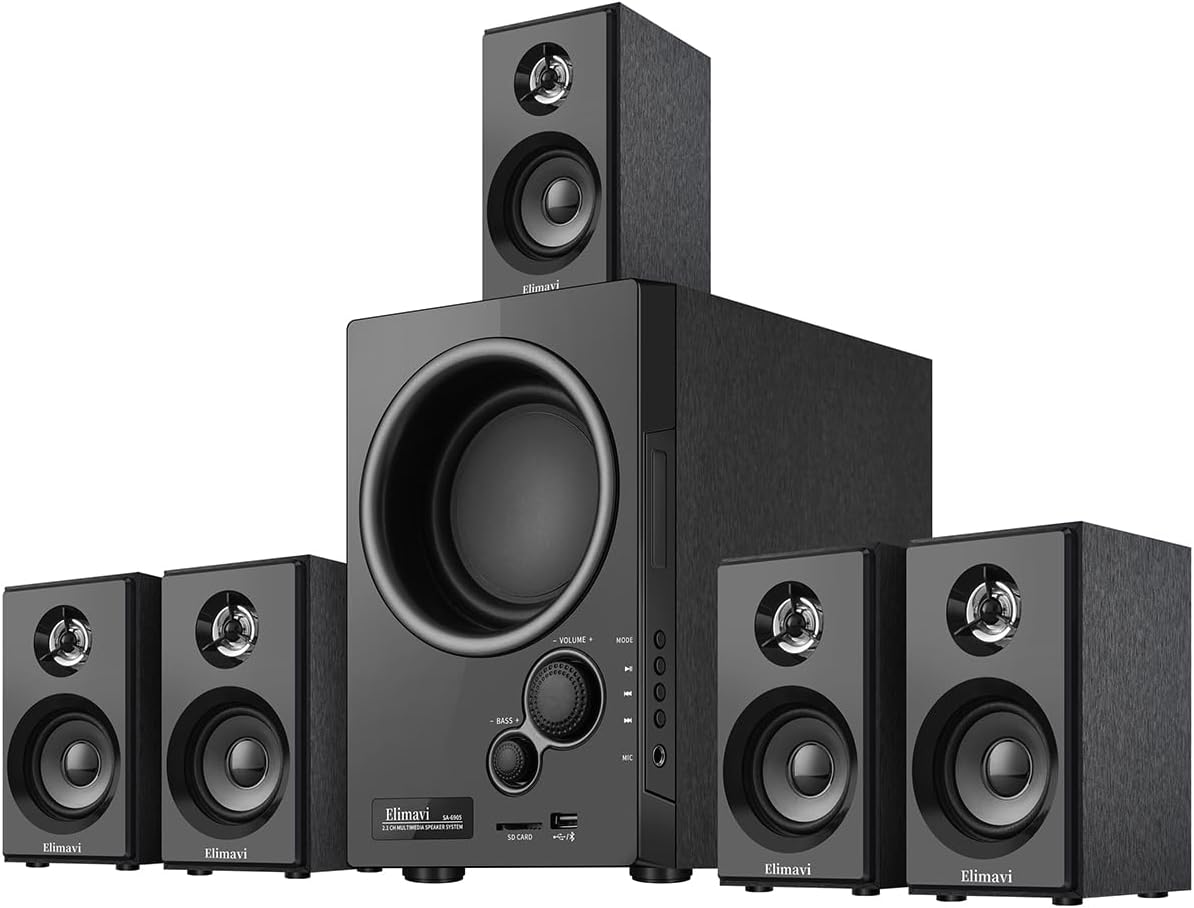
Elimavi 5.1 Home Theater Surround Sound System with 5.5-Inch Subwoofer
Real discrete channels you can place, aim, and measure
You run the wire, and a 5.5-inch subwoofer sets a hard low-end ceiling
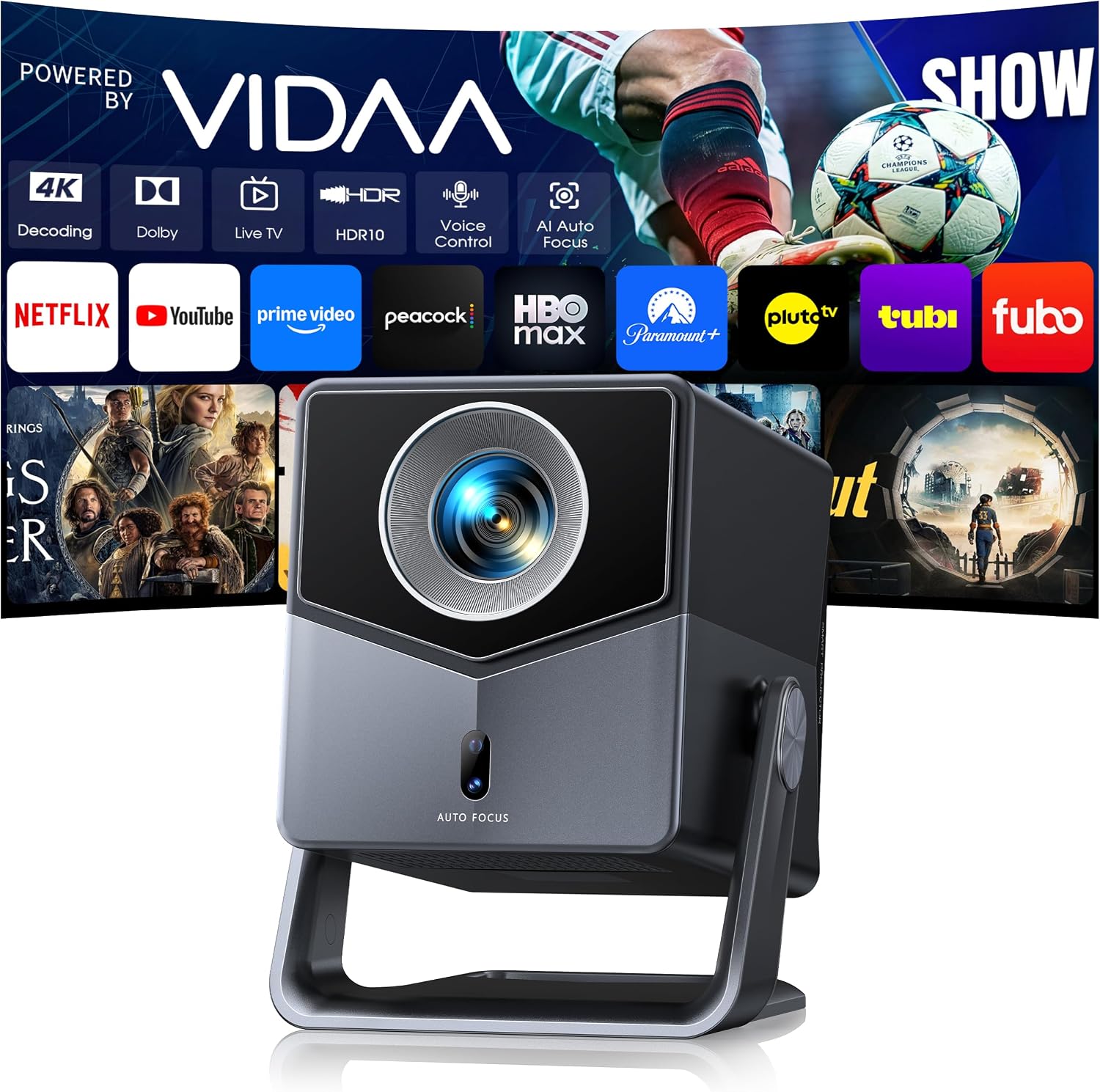
Smart Projector 4K [VIDAA Live TV & 36W Dolby & Voice Control] with WiFi6 and Bluetooth, Short Throw Projector Compatible with Netflix, AI Auto Focus, HDR10, Home Theater Proyector for Outdoor Movies
Streaming built in, short throw placement, auto focus, HDR10, WiFi6
Smart platforms age fast, and brightness decides whether HDR10 means anything
Prices and availability were captured from Amazon Creators API and may change.
How I judge gear that goes in a real room
Every soundbar that comes through my van gets a UMIK-1 sweep from the actual couch before and after its room correction runs. Every projector gets an i1Display Pro pass in Calman against Rec.709, and I publish the delta-E numbers, not adjectives. I am telling you that up front because I have not swept these four units, and I will not pretend otherwise. What I can do is tell you what the spec sheets claim, what the room will do to those claims, and which tests separate a keeper from a return.
Three things matter more than any number on a box. First, the presence band, the 1 to 4 kHz range where dialogue lives. If a bar scoops that out, actors mumble no matter what the wattage says. Second, THD at 60 percent volume. Headroom is a measurement, not a sticker, and a system that compresses before it gets loud was never as powerful as advertised. Third, the room itself. My living room has tile floors, an open wall to the kitchen, and a ceiling fan that hums at exactly 60 Hz. Gear has to survive that, plus my wife Alma, a band director who hears a flat note from across the house.
Epson Pro EX9270: the projector you calibrate
The Epson Pro EX9270 is a three-chip 3LCD design, which is the part that matters for a theater. Three LCD panels means no spinning color wheel, so you do not get rainbow fringing on high-contrast edges, and color brightness tracks white brightness instead of falling off a cliff. It is a 1080p wireless projector built for business rooms, and that background is exactly why it works in a dark media room: it is designed to be installed, aimed, locked down, and left alone.
What that means practically is that this is the projector you calibrate. Feed it a good source, run a proper Rec.709 pass, and you have a picture that a $600 lifestyle projector will not match on color accuracy, because accuracy is a function of panel consistency and a real calibration menu, not marketing. The wireless input is genuinely useful when you want to toss a laptop or a phone at it without pulling a new HDMI run.
The losses are real too. There is no streaming platform inside, so you need a stick, a console, or a receiver feeding it. The onboard audio is business-projector audio, which is to say it exists so that a conference room can hear a spreadsheet. And it is the most expensive path in this comparison. You are paying for panel quality and install-friendly behavior, not for convenience.
Smart Projector 4K: the projector that arrives with the apps
The Smart Projector 4K is the opposite philosophy. VIDAA Live TV is built in, it lists Netflix compatibility, and it takes voice control, WiFi6, and Bluetooth. That combination means one device, one remote, no source box, no streaming stick hanging off the back. For a patio, a bedroom, or a rental where you are not drilling into anything, that is worth more than a calibration menu.
Two features deserve specific attention. Short throw placement means it can sit close to the wall and still fill a big image, which solves the classic problem of a ceiling fan and a coffee table fighting over the same airspace. AI auto focus matters if the projector moves, because it re-establishes a sharp image without you squinting at a test pattern every time someone bumps the table. HDR10 and the 36W Dolby audio claim are the two I would verify first: HDR on a projector only means something if there is enough light output to hit the highlights, and 36W of built-in speakers is a convenience, not a surround system.
The trade-offs are the ones every smart projector carries. The streaming platform is only as good as its update history, and when it stops getting updates you are back to plugging in a stick. Auto focus can hunt on a textured or angled wall. And "4K" is worth checking with a single-pixel test pattern rather than trusting the badge, because pixel-shifting and native panels look identical in a showroom and different on a 100-inch screen.
ULTIMEA 7.1ch: surround without rear speakers
Here is the honest read on the ULTIMEA 7.1ch sound bar: the name says 7.1 channels, the description says virtual surround, and those are not the same thing. Virtual surround is DSP. The bar and subwoofer create the illusion of channels behind and beside you by manipulating timing and level. Done well, it is convincing in a small room. Done badly, it smears the front stage and makes dialogue sound like it is coming from inside a barrel.
What it wins is simplicity. One bar under the TV, one subwoofer, no rear speaker wire, no amplifier, no calibration mic. If your TV is in a room where you cannot run cable to the back wall, this is the difference between having surround-ish sound and having TV speakers. It is also the cheapest way in this comparison to get a real subwoofer in the chain, and a subwoofer does more for movie impact than any amount of channel count.
My test would be boring and specific. Put it in standard mode, not the hyped surround preset, because those presets almost always boost the midrange and wreck the presence band. Sweep from the couch and look at 1 to 4 kHz. Then push it to 60 percent volume and listen for the midrange compressing before the subwoofer does, which is the classic signature of a bar with more marketing watts than real headroom.
Elimavi 5.1: real channels, real wire
The Elimavi 5.1 system goes the other direction entirely. Discrete speakers, five channels plus a subwoofer with a 5.5-inch driver, and the requirement that you place each box where it belongs. Real channels beat virtual channels every single time, and it is not close. When a helicopter pans from front to rear, it moves through actual drivers at actual angles instead of a phase trick.
The cost is labor and flexibility. You run wire, you decide where the surrounds go, and you live with those decisions. A 5.5-inch subwoofer also sets a firm ceiling on low end. Physics does not care about the marketing: a small driver in a small box can play low, but it does it with less output and more distortion than a 12-inch cabinet. That is fine for a living room at sane volumes and wrong for a dedicated theater where you want to feel the room pressurize.
Setup is where this system earns its keep. Front speakers at ear height with tweeters aimed at the couch. Surrounds just behind and slightly above ear level, not in the back corners pointing at the ceiling. Subwoofer placed by crawling, with a 50 Hz sine tone and a tape measure, not by a diagram in the manual. Do those three things and a modest 5.1 system will embarrass a soundbar that costs twice as much.
The pairings, and why each one works
Epson Pro EX9270 plus Elimavi 5.1 is the calibration build. A fixed screen, controlled light, a projector that holds its color, and five speakers you placed on purpose. This is the combination I would install in a media room, and it is the one that rewards effort the most.
Smart Projector 4K plus ULTIMEA 7.1ch is the living-room build. One remote, built-in apps, short throw placement that dodges the ceiling fan, and a bar with no rear wire. It will not measure as clean as the first pair, and it will get used more often because there is nothing to turn on except the projector.
Epson Pro EX9270 plus ULTIMEA 7.1ch is the dialogue-first build. Bright projector for a room with some ambient light, and a bar tuned for voices. Skip it if you watch action movies with the volume up, because that is exactly where the bar runs out of headroom first.
Smart Projector 4K plus Elimavi 5.1 is the small-room build. A short throw projector in a bedroom or apartment, with real surround speakers on stands. Odd on paper, genuinely good in practice, because small rooms are where discrete speakers have the biggest advantage over DSP tricks.
What the spec sheets do not tell you
Wattage numbers on soundbar boxes are marketing, not measurements. Lumens claims from projector makers are optimistic fiction until a meter says otherwise. "Cinema-grade color" is a phrase, not a standard, and I have watched projectors that claimed it measure delta-E above 10 out of the box. "Low latency mode" without a measured number behind it is a checkbox, not a feature.
One more thing that bites people after the install: cable length. I just watched a 30-foot HDMI run fail a 48 Gbps pattern test at the 24-foot mark, and that is with a cable that claimed full bandwidth. If you are feeding 4K from a receiver to a projector, buy the shortest run that reaches, and test it before it goes behind drywall.
Who should buy what
- Dedicated dark room, you will calibrate: Epson Pro EX9270 and Elimavi 5.1.
- Living room, mixed light, family of four: Smart Projector 4K and ULTIMEA 7.1ch.
- Apartment or patio, no drilling, no wires: Smart Projector 4K and ULTIMEA 7.1ch.
- Dialogue-heavy TV watching with one bright window: Epson Pro EX9270 and ULTIMEA 7.1ch.
- Small room, real surround, willing to run cable: Smart Projector 4K and Elimavi 5.1.
If you are honestly in the dedicated-theater column and you have the budget, I will still tell you to skip the bar and buy real speakers, even though that costs me a commission. A soundbar is a compromise that works beautifully in a compromise room. In a room built for sound, it is a bottleneck.
Bottom line
The Epson Pro EX9270 and the Elimavi 5.1 system win on accuracy and on placement, which is where home theater is actually decided. The Smart Projector 4K and the ULTIMEA 7.1ch bar win on being used, which is where most people quietly lose. Pick the pair that matches your room and your willingness to run wire, then spend an afternoon on placement and a calibration pass. That afternoon will do more for the picture and the sound than any upgrade you can buy afterward.