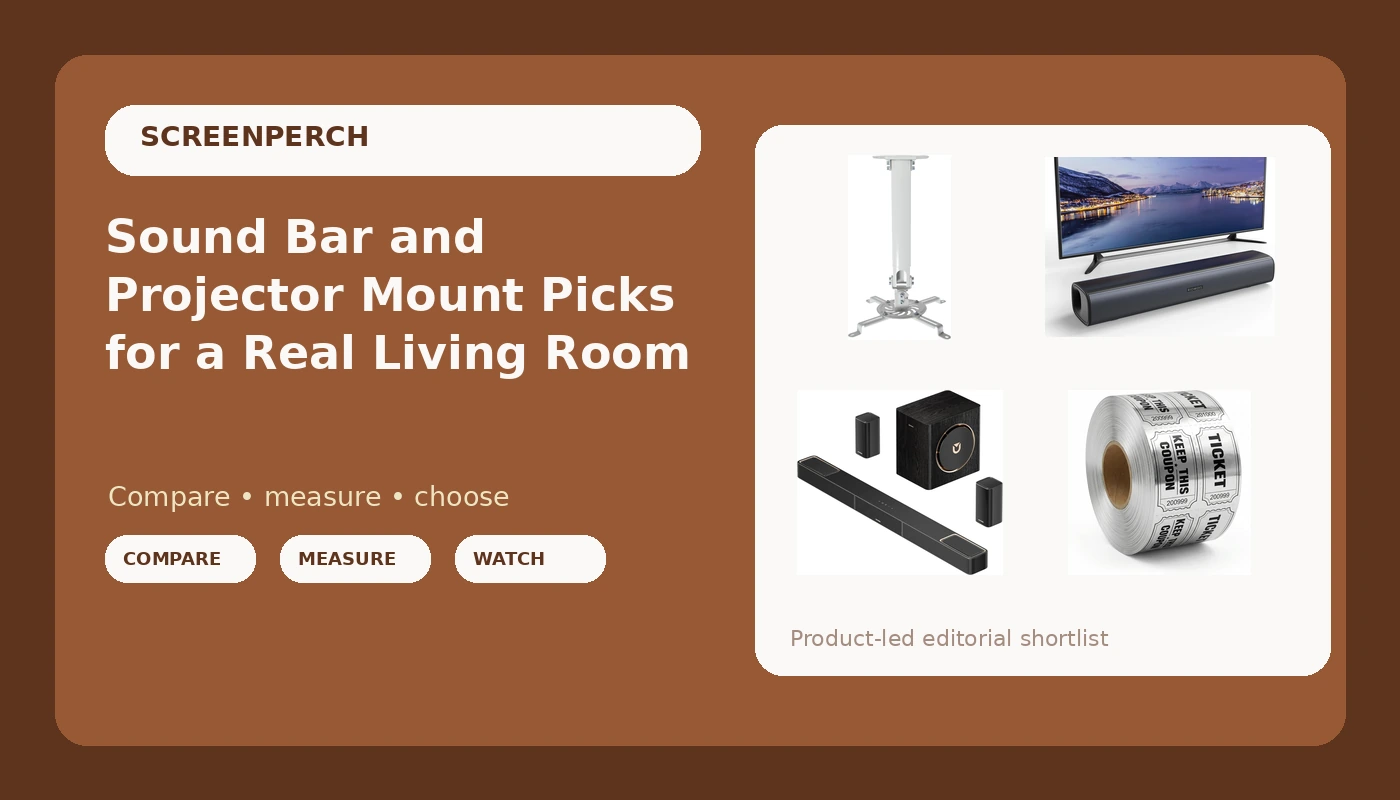
Most home theater sound bar setups get assembled in the wrong order. The bar shows up first, the room gets rearranged second, and the projector mount gets figured out last, usually on the morning of the install. That order is exactly why so many people end up convinced their new gear is broken when the real problem is that the bar is sitting on a shelf below ear height, the subwoofer is wedged into a corner, and the projector is hanging two feet too low.
This explainer covers four pieces that handle the full arc of a movie-night room: a compact budget bar, a 5.1.2-channel bar for a main viewing space, a ceiling mount that puts a projector where it belongs, and a roll of foil entry tickets for the drawings and door prizes that turn a room into an event. Two are audio, one is mounting hardware, and one is not AV gear at all. That mix is deliberate, because not every purchase in a theater room is a speaker.
Related: How to Place a Subwoofer Without Measuring the Room Twice →
Quick answer
Buy the bar that matches the room you actually have, not the room in the marketing photos. A compact 17-inch bar is the right call for a bedroom or secondary TV where a full-width bar will not physically fit. A 5.1.2-channel system is the right call for a main room where you can place surrounds and height speakers properly. A ceiling projector mount is the right call if your projector currently sits on a coffee table or a shelf, because the mount is what lets you set a repeatable drop distance. The foil tickets are the right call only if you are hosting an event with an actual drawing, and they solve an entirely different problem than the other three.
If you can only fix one thing this month, fix placement before you fix hardware. None of these products will outperform a bar that is already at ear height with clear space around it.
Four useful options
| Model | Best fit | What stands out |
|---|---|---|
| RIOWOIS 17" Sound Bar | Bedrooms, secondary TVs, tight consoles | Compact 17-inch footprint |
| ULTIMEA Skywave X40 5.1.2ch Sound Bar | Main viewing room with space for surrounds | 5.1.2-channel configuration |
| VIVO Universal Extending Ceiling Projector Mount | Projector setups that need a set drop distance | Height-adjustable extending ceiling mount |
| Silver Tickets Metallic Foil Raffle Tickets | Movie nights with drawings or door prizes | One roll of 1,000 foil tickets |
The small-room starting point: RIOWOIS 17" Sound Bar
A compact bar is a compromise, and it is worth knowing which compromise you are accepting. A 17-inch cabinet does not hold much driver area or internal volume, so plan for it to work well in a small room at sane listening levels rather than to fill a great room at reference volume. That is not a flaw, it is physics. The practical move is to set the bar at ear height with nothing blocking the front of it, then play a dialogue-heavy scene before you touch a single sound mode. If the voices are intelligible, the bar is doing its job. If the box says surround and the effect sounds thin, remember that a single bar has no way to put sound behind you, so treat any surround claim as an enhancement to the front stage rather than a substitute for real rear speakers.
The main-room upgrade: ULTIMEA Skywave X40 5.1.2ch Sound Bar
The number to pay attention to in 5.1.2 is the last one. Five ear-level channels plus a subwoofer channel is familiar territory, but the two height channels are the part most buyers never actually place. Height effects only pay off when those speakers have a clear path to the seating position and are not buried behind a couch or inside a cabinet. Before you order any surround system, walk the room and answer one question honestly: where do the surrounds go? If the answer is "somewhere behind the couch, I guess," a cheaper bar with a good presence band in the dialogue range will probably make you happier for television. If the answer is a real, measurable position on a wall or a stand, the extra channels earn their keep. Also confirm how the surrounds connect before you buy, because a wireless surround pair and a wired pair are very different installs on a tile floor.
The mounting piece: VIVO Universal Extending Ceiling Projector Mount
A ceiling mount is the least glamorous purchase in a theater room and the one that most often decides whether the room feels finished. The reason is throw distance. Projector throw is measured from the lens to the screen, not from the back wall to the screen, and a mount with an extending, height-adjustable column lets you dial in that distance instead of stacking books under a projector on a side table. Two things to confirm before ordering: that the bracket fits your projector's footprint, and that your ceiling has a joist where you need it, because a projector hanging from drywall alone is a countdown timer. If you have a ceiling fan in the room, check whether the projector's light path crosses the blades, since a spinning fan in the beam causes visible flicker and a hum you will hear during quiet scenes. The white finish is a small thing that matters more than people expect in a light-colored room.
The odd one out: Silver Tickets Metallic Foil Raffle Tickets
Plenty of home theater rooms pull double duty. A finished basement becomes the neighborhood screening room, the church youth group borrows it for a movie night, or the classroom projector gets rolled out for a reward day. The moment a room hosts people, you need a way to hand out entries, run a door prize, or track a drawing, and that is the problem a roll of foil tickets solves. It is worth being clear about what this item is not: it will not improve your sound, your picture, or your mounting angle. It is a consumable for an event. If you run a paid raffle rather than a free drawing, check your local rules on how those are conducted, because that is a legal question and not a gear question.
Prices and availability may change. Product images, names, and retailer links are matched to verified listings. No current price, rating, stock status, or measured result is stated here without current evidence.
What a channel number actually promises
A 5.1.2 label tells you how many discrete channels the system can address, not how good any of them will sound. Five ear-level channels and one subwoofer channel cover the front stage, the sides, and the low end. The two height channels are a separate layer meant to place effects above the listener, which is why they are so dependent on the room. Height speakers firing into a low ceiling or aimed at the back of a couch contribute almost nothing. Positioned with a clear path to the seats, they add a sense of vertical space that a bar alone cannot fake.
The other number that rarely appears on the box is where dialogue lives. The 1 to 4 kHz range carries most of the intelligibility in speech, and it is the first thing a badly tuned sound mode ruins. A "movie" or "surround" preset that hypes the midrange can make explosions feel bigger while turning every conversation into a mumble. That is why the honest test for any bar is a quiet dialogue scene, not a trailer.
Headroom is the third thing a channel count hides. A system with plenty of amplifier headroom stays clean as you turn it up. A system without it starts compressing and distorting well before the volume knob reaches its limit, and the distortion shows up first in the midrange, which is exactly where dialogue sits. Wattage printed on a box is a marketing figure, not a measurement, so treat it as a rough tier indicator and nothing more.
How to plan the room before the gear arrives
Order of operations is everything in this category, and the sequence below is the one that saves returns.
- Pick the seating position first. Screen size, speaker layout, and projector placement all follow from where the couch actually goes.
- Measure throw distance from the lens position to the screen, not from the wall behind the projector, and subtract the mount drop from that figure.
- Decide where surrounds and height speakers can physically live before buying a 5.1.2 system. If there is no position, the extra channels are decoration.
- Test the subwoofer in more than one spot. The room shapes bass response more than the driver does, and a corner is not automatically the answer.
- Set the bar at ear height with clear space in front of it, then listen to dialogue before you enable any sound mode.
What to check before you order
- Confirm the bar's physical width and depth against your console or shelf, because the listing dimensions are the ones that will arrive.
- Check whether the surround speakers need power outlets or a cable run, since a wireless pair and a wired pair are different installs.
- Verify that your ceiling has a joist where the projector needs to hang, and that the bracket fits your projector's footprint and weight.
- Decide the drawing or prize format before buying tickets, because roll tickets suit entry and door prizes rather than assigned seating.
- Keep the packaging and the receipt until the return window closes, since placement problems often reveal themselves in the first week.
Which option should you choose?
Choose the RIOWOIS 17" Sound Bar when the TV lives in a bedroom or a secondary space and a full-width bar will not fit on the furniture you own. Choose the ULTIMEA Skywave X40 5.1.2ch Sound Bar when you are building out a main viewing room and you can genuinely place surrounds and height speakers instead of tucking them behind the couch. Choose the VIVO Universal Extending Ceiling Projector Mount when your projector is currently on a table or a shelf and you need an adjustable, repeatable drop from the ceiling. Choose the Silver Tickets Metallic Foil Raffle Tickets when the room is hosting an actual event with a drawing, a door prize, or class rewards, and treat it as event logistics rather than audio gear.
Listings change, and the details that decide a specific room are the ones you should confirm on the product page before ordering: surround connection type, mount weight rating, and projector throw requirements. Nothing here replaces measuring your own space, and no channel count or wattage figure substitutes for listening from the seat you actually use.
The bottom line
A home theater sound bar setup is a placement project with a shopping list attached. The bar matters less than where it sits, the channel count matters less than whether the extra channels can be placed, and the ceiling mount is the piece that decides whether the image is comfortable for a two-hour movie. Start with the room, buy the item that solves the room's real constraint, and leave the foil tickets for the night you invite everyone over.